
Translator’s Preface
This is the 4th guest essay that I am sharing as part of our ongoing series on the topic of Roman Catholic eucharistic miracle claims,1 and the second installment specifically addressing the Lanciano miracle.
The original version of this essay is written in French by Maxime Georgel, a French-speaking Reformed apologist who runs the “Par la Foi” blog and YouTube channel. As with the previous essay in this series, Maxime's medical background makes him far better equipped than I am to assess the scientific claims involved.
I asked Maxime for his permission to translate this essay as well, which he graciously granted. Beyond translating, I also made a few edits to the piece with his approval. First, I reorganized the essay for clarity by adding a numbering apparatus to each section, along with a brief summary of Ethan Muse's argument immediately preceding Maxime's refutation of it in each case. Second, in section 3.1, I slightly reframed the argument under discussion, since Muse has actually revised his own framing of the point Maxime was originally responding to there. In every case, Maxime reviewed and approved these changes before publication, and any translation errors (or otherwise) that remain are my own.
Thank you to Maxime for continuing to let me share his work, and thank you to those of you who take the time to read it — hopefully it proves just as helpful as the last installment.
Without further ado, here is Maxime’s essay…
Response to Ethan Muse On the Alleged Eucharistic Miracle of Lanciano — Dr. Maxime Georgel
My article on the miracle of Lanciano, published some time ago, was intended, among other things, to respond to the arguments of a certain Ethan Muse. He undertook a response on his site, which I invite you to read and which will be addressed here in the order of the objections he raises. The article that follows is of little interest if you have not read his response, and his response in turn can only be understood by someone already acquainted with my original article (so please be sure to read those first!).
Before turning to the substance, I wish to commend the effort and energy invested in this study; may they serve the advancement of truth.
The Structure of the Case
Because the discussion that follows is necessarily granular and grows technical in places, it is worth pausing here to fix the logical architecture of the claim under examination, so that the reader knows exactly what a given finding would establish if confirmed, and where each piece fits in the larger case. First, however, a few general remarks.
My general conclusion regarding what was presented at Lanciano is simply that the results are not sufficiently conclusive to be affirmative. This conclusion plays out across various points that we will address in the article;
Whatever is on display in that convent today, the miracle thesis must also provide good reasons to think that what is currently there was once a host.
The thesis that a miracle occurred at Lanciano, then, is not a single proposition but a conjunction of several, each of which must hold for the conclusion to follow:
that what is displayed in the convent today is human cardiac tissue and human blood;
that this material was once a consecrated host;
that its present state reflects a miraculous preservation across the centuries; and
that no naturalistic account—in particular, no medieval forgery—can plausibly explain the whole.
These propositions form a chain, and a chain is only as strong as its weakest link. Crucially, most of the individual scientific findings invoked by the miracle’s defenders—the macroscopic appearance, the histology, the Uhlenhuth result, the blood type, the chromatography, the electrophoretic profile—are not probative in themselves. Their argumentative function is to serve as premises in a cumulative case for the implausibility of a fraud. It follows that wherever one of these premises is shown to be uncertain, the cumulative argument is weakened in proportion; and a conclusion is never more secure than the premise on which it rests.
This response is organized around that architecture. Part I examines the evidentiary foundation on which everything else is built: the fact that the entire scientific case descends from a single, unsupervised investigator. Part II takes up, in turn, each finding offered to identify the relic and to render a forgery improbable. Part III turns to the historical record and to the decisive question of whether what we observe today was ever a host. Part IV addresses the claim of miraculous preservation. A concluding section draws the threads together.
Let us turn, then, to the response to Ethan Muse; throughout, I follow the order in which Muse raises his objections in his article rather than the order of my original article.
How This Debate Could Be Settled
Finally, one point worth recalling in every discussion of this miracle is that many of the open questions about Lanciano are, in principle, resolvable. Indeed, a large part of the debate stems from the fact that the analyses carried out were done with 1970s techniques and without proper oversight. If the convent were to authorize and organize a new controlled study with genetic analysis, carbon-14 dating, and mass spectrometry—analyses that are no longer so costly today—the benefit would be immense. If the conclusions presented to pilgrims are true, then why not employ every means at our disposal to render them indubitable? Dr. Serafini maintains close relations with the convent, having been able to analyze documents found there and access Dr. Linoli’s correspondence with them: why not offer them this opportunity? If the results are as conclusive as he claims, then he has nothing to fear from these analyses.
I also want to note that the interest in further analysis is raised primarily by those who object to the miracle. Dr. Kelly Kearse, himself a Catholic, has proposed an analysis protocol for alleged eucharistic miracles, some elements of which could be adapted for Lanciano.2 Dr. Stacy Trasancos, also a Catholic, called—from her earliest articles on this subject, and before she was attacked as a bad Catholic for objecting to this miracle (which no Catholic is obliged to believe)—for the formation of a team willing to conduct proper research on the matter. Professor Silvano Fuso likewise lamented, 20 years ago, the difficulties in obtaining permission to investigate the question. In 2009, he maintained: “Furthermore, the analyses carried out to date say nothing about the age of the relic. From a scientific standpoint, this aspect is certainly the most interesting, and it would be worthwhile to undertake new research—for example, carbon-14 dating, which would require only a few milligrams of material, a quantity certainly less than that already used for the previous tests.”3 There is no reason this call for a more thorough investigation should be borne by the miracle’s detractors alone, since its defenders, too, acknowledge the limitations of the 1970 study—limitations that current techniques and a more rigorous protocol could, for the most part, remove. Accordingly, I urge our apologist friends to write no further on Lanciano without appending, in a preface or conclusion, a call for further studies. If this request comes from sources not perceived as hostile, it has a better chance of succeeding.
Let us turn, then, to the response to Ethan Muse; throughout, I follow the order in which Muse raises his objections in his article rather than the order of my original article.
Part I — The Evidentiary Foundation: A Single, Uncontrolled Investigator
The whole edifice rests on one man’s unsupervised work. Before weighing any individual finding, then, we must weigh the conditions under which every finding was produced.
1.1 Linoli’s bias
Muse’s objection (summarized): Linoli did not prejudge his conclusions: before extracting any fragment he feared the degraded sample would yield nothing of value, and his identification of myocardial tissue was independently corroborated by Dr. Bertelli—reportedly an unbeliever—so the charge of bias collapses.
1.1.1 What Is at Stake
This section matters because, if I am right, the entire scientific case for the nature of what the convent displays rests on a single physician—on his competence, his probity, his care. For a claim of the miraculous, that is a structural weakness.
1.1.2 Response
Muse begins by recalling my assertion that Linoli already believed in the miraculous nature of the object he was about to examine—a point I consider a potential source of bias (for context, in critical appraisal of a scientific article, prevarication bias must be raised when analyses are carried out without controls). This bias does not mean that the author lied or was selective in what he presents to us, but that we have no way of knowing for sure: a good study must contain controls to prevent this bias. In my article, then, I also note the fact that Linoli believed, even before his study, in the miraculous nature of what he was examining. Furthermore, he had been chosen by the convent to carry out the investigation. These are elements that make the lack of controls all the more troubling. No drug, were it tested without controls and at the request of the laboratory that produces it, would be authorized for marketing in Europe due to this potential bias. It seems to me that if the claim of a miracle is to rest on assertions of a scientific nature, these must be established according to the rules the discipline usually requires.
Muse tries to rebut this with a quotation that does not touch my assertion at all: it shows only that Linoli feared, at the outset, that he would draw little of value from the samples. Both of these things could be true at once: he may have believed that what he was about to examine was miraculous, and at the same time believed that it would be difficult to draw any valid information from the samples. In any case, prevarication bias must be raised whenever there is no control in a study, regardless of what may be said about the examiner’s probable dispositions.
Muse’s second point is that another physician—an atheist, according to Dr. Serafini, who reportedly spoke with the man’s grandson—corroborated Linoli’s analysis. This other physician’s opinion does not appear in the protocol of Linoli’s study, but in a letter appended to it. This opinion, as I noted in my article, depends entirely on the selection of sections that Linoli was willing to send his colleague, and therefore does not satisfy the criteria of a control in the scientific sense of the term.
In short, this first section produces nothing that genuinely contradicts my assertion: Linoli did indeed believe, going in, that what he would examine was miraculous, and that belief is a standing risk of bias. My assertion is simple and contains no formal accusation at this stage. It is merely a statement of facts. If a medical student were questioned about such a study in the subject known as Lecture Critique d’Articles (Critical Appraisal of Articles), he would have to tick the box on his multiple-choice exam: “prevarication bias.” I recall that Dr. Serafini, a defender of eucharistic miracles, also notes this weakness:
Any weaknesses? The whole investigation was carried out by Prof. Linoli alone. There was no supervisory committee: he took the samples, and these were analyzed by him and him alone.4
This observation was also offered, more pointedly, by the professor of biology Antonio Casolari, in these terms:
The analyses intended to demonstrate scientifically the reality of the miracle should have been entrusted not to a single person, but to a panel of experts with varied competencies. Given the nature (plant or animal) of the materials to be analyzed, this panel should have included at minimum a chemist, a physicist, an anatomical pathologist and histologist, a biologist, and a statistician. By agreeing to conduct these analyses without the support of such a group, and despite the more than reasonable uncertainties as to the authenticity of the relics, Professor Linoli was certainly aware of the limited, indeed nearly nonexistent, scope of the results obtained. One may suppose that he accepted this task more to satisfy a personal curiosity or to bolster his Christian faith than to arrive at a scientific demonstration of universal value. […] Absence of a panel of experts at the time of sampling : This absence deprives the sampling operations of the indispensable guarantee that the material analyzed actually came from the alleged relics of the miracle. The presence of monks has no scientific value, since they were interested parties—hence not neutral—and did not possess the requisite competencies. The material analyzed could in fact have been taken from anywhere. This does not mean that Professor Linoli is not trustworthy when he states that he took the samples from the relics; his declarations are certainly credible, but they are devoid of the scientific guarantees that the presence of experts would have provided.
Professor Bertelli (professor of normal human anatomy at the University of Siena), consulted by Professor Linoli at the conclusion of the analyses, made clear that he knew the origin of the preparations examined only from Professor Linoli’s declarations. He had attended neither the sampling operations nor the preparation of the histological samples. He stated: “A series of histological preparations was submitted to me by Professor Linoli—according to his formal declaration—as coming from a host…”. It follows that Professor Bertelli’s opinion does not constitute testimony as to the nature of the relics, but only as to the characteristics of the preparations examined.5
The absence of any other scientist during sample collection should deeply trouble anyone who cares about rigor and objectivity in investigations of this kind. To repeat Casolari once again: “The material analyzed could in fact have been taken from anywhere. This does not mean that Professor Linoli is not trustworthy when he states that he took the samples from the relics; his declarations are certainly credible, but they are devoid of the scientific guarantees that the presence of experts would have provided.”6 This is, in substance, the very point I have been making: not that Linoli lied, but that we have no way of being sure. Once again: prevarication bias.
1.2 The Forged WHO Report
Muse’s objection (summarized): The convent stored the forged WHO report in good faith; the 2005 ZENIT interview does not establish Linoli as its source; and the genuine “prime suspect” is Professor Giuseppe Biondini, the figure actually credited in the document.
1.2.1 What Is at Stake
The following section matters not so much in itself, but as a discussion adjunct to the one on prevarication bias: the existence of a forged report relating to this miracle raises questions and makes it all the more desirable that proper controls and checks had been carried out on the study.
1.2.2 Response
As I noted in my first article, since at least 2005 until the present day, false information has circulated that a report from the WHO and the UN supposedly confirmed Dr. Linoli’s analysis. This report was stored for years in the very Lanciano convent itself, and its conclusions were presented to pilgrims throughout that time. However, despite all the fanfare and intrigue, this report turned out to be a forgery (and a rather crude one at that); no one disputes this any longer. In my article, I inquire into the possible origin of this report and note that it began to circulate in articles written on the occasion of a conference that Dr. Linoli gave together with others. Given that Linoli conducted the study at the convent’s request, I state in my article that the existence of a fraud stored for years right in the convent raises questions as to the integrity of the persons involved, and I suggest that Linoli is, along with the convent, one of the possible suspects in the fabrication of this affair. In my article, I go so far as to say that Linoli is “suspect number 1”. It would be helpful if this fabricated report were made public in its entirety, something the convent seems reluctant to grant even though it possesses a copy in addition to the original.
Ethan Muse responds that the convent may well have stored this document in good faith, since the monks were not medical experts able to judge its veracity. This is true with respect to the analysis of the documents in themselves. But it overlooks an important element: this report claimed to be the result of hundreds of analyses conducted by a WHO and UN commission on the relics of Lanciano, in order to check Linoli’s analyses. It is an insult to the intelligence of the convent’s religious to think they could have believed such a study had been carried out without their being notified of new sampling and without having met any representatives of this commission;
Secondly, he says that the 2005 ZENIT article does not formally establish that Linoli is the source of the information relating to this report. I grant him this. My article is not a formal accusation: to be a suspect is not the same as being the culprit. I am simply surprised that Linoli did not communicate publicly about this fraud, even though it spread through articles reporting interviews with him;
Thirdly, he says that the prime suspect should be Professor Giuseppe Biondini rather than Linoli, because Biondini’s name appears on the report. We cannot access this report, and the convent allowed Dr. Serafini to do so only on the condition that he take no notes and cite it in no publication. It simply happens that, after a good deal of research while writing my article, I was unable to find any mention of a Giuseppe Biondini anywhere else. I therefore did not even know whether the existence of such a man had actually been established or if the name was a pseudonym. Ethan Muse then mentions, without providing a source, that literature about the Shroud of Turin contains this same name. Using this information, I was able to locate a document written by a Salesian dealing with the Shroud, which thanks a Giuseppe Biondini for having provided him with photographs. I am not able to say whether it is the same person mentioned in the report. In fact, Dr. Serafini, who consulted the report, himself states:
“The report appears to be the work of a commission involving several European scholars, whose names, fifty years later, are invisible to modern search engines (perhaps because they are fictitious names?). However, it is clear from reading the first few pages of the text that the coordinator, the person who had the original idea of involving the WHO in the study of the miracle of Lanciano, was an Italian doctor and biologist named Giuseppe Biondini, “full member of the WHO Executive Board”. He allegedly became aware of Linoli’s work in 1972 and involved the WHO the following year. The work of a specially constituted commission was then published in December 1976.
Even for Prof. Giuseppe Biondini, it is not possible to find any reference on the internet to scientific activities or publications other than this elusive dossier on Lanciano. I really cannot say, and therefore I cannot rule out, that the opacity of this whole operation goes so far as to invent the existence and name of Prof. Biondini himself... I would like to point out that the WHO archive available online contains a reference to a Mr M. Bandini (and not G. Biondini) as a member of the Executive Board in 1973.”
Before considering Biondini the prime suspect, we would need to ascertain whether this man, supposedly a member of a WHO board, actually existed. To date we have little reason to believe he did, nor do we have any record of correspondence between the convent and this man. Thus, his prime suspect is a professor whose existence is unproven, and for whom we have no trace of correspondence or connection with the convent or with the WHO. All we have is a document on the Shroud containing the same name—a name that may very well have been borrowed from that person, or invented like the other names on the report. There are more than 400 Biondini families in Italy, and the first name Giuseppe has appeared in the top 10 in more than one year in that country: it would be like speaking of a Dr. Joseph Leblanc in France. In short, it seems to me that since this report appears otherwise to contain only unknown/invented names, and since we find no trace of a Professor Biondini nor any person of that name in the WHO, one cannot retain as the principal suspect a possibly nonexistent man!
Muse closes the section with two further points in defense of Linoli’s integrity—and to his credit, for I have no particular interest in incriminating the man. The first is Dr. Serafini’s statement that Linoli never mentioned this report between 1970 and 2006 in his exchanges with the convent. However, this observation is hardly surprising, since it seems that the report only began to circulate in 2005 onward; additionally, it is hard to imagine that someone involved in a fraud of this kind would keep written records of it. The second point is the fact that in a 1977 letter, Linoli took care to ask the convent to correct a booklet that described the blood and flesh as living and that reported the legend of the equal weight of the blood clots (an element we discussed in my first article); this demonstrates a certain concern on Linoli’s part to ensure that his research wasn’t associated with claims that were obviously false, even upon a superficial reading. But these facts belong to a wholly different order from the claim that a commission validated the results: the one concerns assertions that are manifestly pseudo-scientific, the other a report credible enough that Dr. Serafini drove five hours to read it.
These two points raised by Ethan Muse actually come from a recent article by Franco Serafini, to which Dr. Trasancos had responded in these terms on her blog:
Serafini seems to be gatekeeping his own narrative on the WHO report because he discovered the fraud, for which I am thankful. He reacted to my suggestion that Dr. Edoardo Linoli may have known about the WHO report and said nothing publicly. In response, he posted a letter showing that Linoli knew of serious exaggerations being circulated about Lanciano, though not specifically the WHO report, and still did not correct them publicly. So, I added a note to my post to clear that up, pointing out there is only a single document, a photographed letter from Serafini to that effect, which I have not independently authenticated beyond the image he shared. Serafini says he’s going to devote his Substack to countering my criticisms for the next few months.
To be continued, then!
Beyond the question of whoever the culprit may be, one conclusion remains paramount: the study was carried out under no control beyond what Linoli chose to exercise over his own work—commissioned by the convent, already convinced of the miraculous nature of what he was examining, and operating in the shadow of a later fraud attached to that very miracle. This fraud served precisely to create the illusion that his analyses had been verified. Whether he is highly suspect or barely suspect of being involved in the production of the fraudulent report stored in the convent is a relevant debate, but one that does not affect this conclusion: as explained earlier, it is simply a question adjunct to it.
Part II — The Identification of the Relic
The findings examined in this part—macroscopic, histological, immunological, serological, and chromatographic—are not, individually or jointly, proof of a miracle. Their role in the apologetic case is narrower and wholly derivative: each is meant to function as a premise in the cumulative argument that a medieval fraud is improbable. Each is assessed here with that function kept in view.
2.1 Macroscopic Anatomy
Muse’s objection (summarized): The relic macroscopically corresponds to a transverse section of a left ventricle, and a pre-modern forger would have had neither the means nor any motive to simulate a heart—so the correspondence tells for authenticity, not against it.
2.1.1 What Is at Stake
Across the various accounts of the miracle, the relic’s macroscopic appearance is described—sometimes in lavish detail—to support several distinct claims: that the object answers to a cross-section of a heart, that the cut is too clean for a medieval forger, and so on. The appearance is not probative in itself; but the identity of what pilgrims venerate can serve as a premise in a probabilistic argument against the likelihood of a fraud.
2.1.2 Response
Let us recall what Linoli asserts regarding the macroscopic appearance, according to the summary offered by Dr. Serafini:
The macroscopic study was also surprising. Linoli’s focus was on the fourteen small circular holes punched along the entire external edge of the relic, as if, in a remote past, it had been necessary to fix the Flesh with fourteen nails onto a wooden support to counteract the retraction and shrinkage of rigor mortis. Thus, the Flesh would have retracted toward the outer nails, giving rise to the hollow space currently present in the middle. However, according to the professor, this cavity was also partly pre-existent. Therefore, still to this day, the relic macroscopically resembles a complete heart cross section, or possibly a cross section just through the left ventricle.7
Linoli thus proposes to us that the reason there are small holes (presumably caused by nails securing the relic, unless they were rigid wires) is that the heart, still living at the moment of its fixation, was contracting under the effect of rigor mortis. It is hard to read these lines without smiling, so much do they belong to the realm of fantasy rather than science. All we see is a mass that was fixed in place; it may have been fixed simply to hold in a suitable shape within the reliquary, and not to counteract a contracting living heart (and why not, while we’re at it, to withstand the beating of that heart?). On the contrary, these holes offer us a good reason to conceive how some mass could have ended up with a cavity at its center—not through the contraction of rigor mortis, but through that of the progressive desiccation of the relic fixed around its perimeter.
Regarding the macroscopic appearance, Muse next takes up my summary of Professor Budetta’s analysis. This professor, after a visit to the convent, put forward the hypothesis that the anatomical specimen was produced by a forger using a modified child’s heart. This professor specifically did not attempt to examine the chemical and immunological data or the histological sections, on which he offers no comment but which he agrees to presuppose: he thus proposes an analysis that would have conceded absolutely all these observations. One cannot therefore, as Ethan Muse does, assert that this professor, after examination, concluded that human origin had been proven beyond all reasonable doubt, nor that he personally took a look at the sections and concluded that it was indeed a heart. Indeed, in the way Ethan Muse’s paragraph is constructed, it seems that this would be the conclusion reached by this professor after examining the data, whereas that is precisely not what Budetta’s sentence says. I give you below Ethan Muse’s quotation and then that of Budetta’s original article:
[I]t is worth noting that, after “listening to the scientific explanations of Professor Odoardo Linoli,” Professor Budetta wrote “science has established that [the relics are] indeed a piece of human heart and coagulated human blood.”
— Ethan Muse
My doubts arose while listening to the scientific explanations of Professor Odoardo Linoli, who, among other things, asserted the presence of a portion of the interventricular septum in the cardiac cavity.
— Budetta
In other words, the sentence about listening to Linoli’s explanations does not relate to the conclusion that science had established the human origin of the relics, but to the origin of Professor Budetta’s doubts! Muse does not, of course, invent the sentence he quotes: Budetta does assert that science has established the human origin of the relics and their identity as a heart—but, as I explained, this is a conclusion he grants at the outset, not one he examined or defended himself.
Muse then answers Budetta by claiming the relic is a left ventricle only, not a whole heart (Budetta had hypothesized a child’s heart altered by a forger)—a claim that does not even match Linoli’s own final view, which envisaged a cross-section of a whole heart (as he noted). He adds that even if the relic roughly has the appearance of a heart, this retains value because he does not see why a pre-modern forger would have attempted to reproduce a heart: it would be a difficult maneuver to carry out and one offering no added value. I leave it to each reader to weigh the force of this consideration in light of the points highlighted above—namely, the possibility that the observed cavity may not have retained the appearance of the tissue originally fixed. If the central cavity formed through retraction, or was considerably altered by this process, then the remarks about its present appearance remain highly speculative. Thus, Professor Antonio Casolari noted:
The relic is “largely torn in the central area, owing to the retraction of the tissue toward the periphery.” It is very plausible that this tear results from the tension exerted to make the slice of muscle circular, leading to a progressive weakening of the tissue, particularly at its center. This tear would have begun shortly after fixation on the board and would have grown more pronounced during the dehydration process.
The dehydration would have occurred while the tissue was still fixed to the support, which would explain the preservation of its circular shape, suited to its display in a monstrance. Otherwise, the fourteen holes present on the edge would make no sense. They cannot, in fact, have served to fix the relic between the two glass plates of the monstrance.8
Muse then repeats his argument about the supposedly laminar character of the section—to which we have already responded and to which I will return in the section that follows.
2.2 Histology
Muse’s objection (summarized): The cited histology professor’s verdict should be discounted: it is anonymous, it rests on images of poorer quality than Linoli’s own slides, and the professor was unfamiliar with the Ignesti stain and unaware that the images derive from a single cubic millimetre.
2.2.1 What Is at Stake
The stakes here match those of the preceding section: the identity of what is displayed proves nothing by itself. It may, however, figure among the premises of an argument holding that it is unlikely a medieval forger would have used a human heart rather than some other, more readily available material.
2.2.2 Response
Muse now turns to what is, by his reckoning and mine, the most important part of my article: the opinion of my histology professor on the sections.
First, he notes that the opinion is anonymous and therefore rests entirely on my testimony. I cannot, in fact, broadcast the identity of my professor without his consent, as this would inevitably draw him into a religious controversy. I nonetheless have a fairly simple solution to this problem: Ethan Muse and I both know Matthieu Lavagna. The latter is also Catholic and has written articles and book chapters defending the authenticity of the Lanciano miracle. He is therefore not biased in favor of the thesis I defend. I meet him from time to time during the year when he passes through the Lille metropolitan area; I therefore invite him to freely consult, on his next visit, my email exchange with my professor, which I have in any case reproduced in my article. He will also be able, having access to the professor’s name, to verify everything I assert concerning his publications and qualifications, which are far superior to Linoli’s. Another, even simpler solution would be for me to forward these emails to the entire Par la foi team—something I did via screenshots as my exchange progressed, and which I can do again. After all, it is less likely that a team of nearly 10 people would all agree to lie;
Secondly, he argues that my professor had images of lower quality than what Linoli could observe under his microscope. This is correct, but I had anticipated this remark by recalling that Linoli held that: “The illustrations accompanying this text are sufficient in themselves to confirm this diagnosis, irrefutable despite the limitations of tissue staining.”9 Dr. Serafini likewise assures us that the identification is unmistakable, in an excerpt quoted by Muse in his article. Thus, the images are supposed, despite their limitations, irrefutably sufficient to confirm the diagnosis;
Thirdly, Ethan Muse relays Dr. Serafini’s disconcerting remark that analyzing these images without knowing that they come from the same cubic millimeter would distort the entire analysis. This assertion is gratuitous and partly false: the images produced in Nasuti’s report come from two distinct histological analyses on two samples. Moreover, the idea that this would change the interpretation needs to be argued for (not just asserted): what would my professor have discovered had he known this? Dr. Serafini further points out that my professor was unfamiliar with Ignesti’s trichrome stain. This point has already been addressed in my article, because I sent my professor a note on this stain, which he reviewed before his final analysis. I also wrote at the time: “Before giving you his response, I should mention that I also sought to understand why the Ignesti method was unknown to him: this method appears only in Italian sources, seems quite old and outdated, likely due to lack of specificity. It is said to be named after Ugo Ignesti and was a trichrome stain used for muscular pathologies.” It would be good for Serafini (who is a cardiologist, and therefore doesn’t observe sections daily like an anatomical pathologist) to explain to us what my professor would unfailingly have noticed had he been familiar with this trichrome (which Serafini misspells, by the way: could it be because he’s just discovered it himself?). Here, it may be useful to clarify for the lay reader that a cardiologist usually has no expertise in interpreting a histological section, even a cardiac one. Indeed, I completed cardiology rotations during my own training, and I know full well that while a cardiologist regularly interprets electrocardiograms or echocardiograms, they can very well go through their entire career without ever observing a single section of the heart. A cardiologist, indeed, treats heart diseases. He has no need to identify sections in order to know whether it is a heart: he already knows his patient has one and seeks to keep it healthy. The specialist who is called upon to examine sections is the anatomical pathologist, which is precisely why I called upon a professor of that specialty. So when Ethan Muse points out that Dr. Serafini is a cardiologist as if this were an argument resting on someone with particular competence to interpret histological sections, he is simply mistaken;
Muse then returns to the longitudinal character of the section, which he takes to demonstrate a cut of surgical precision beyond any medieval forger. I objected to this that Linoli himself notes that some fibers are of varied orientation, which is indeed observable on the sections. Ethan Muse replies that they remain predominantly longitudinal. Here, I would like to remind Ethan Muse that these remarks bear on a sample (or rather two samples) of one cubic millimeter, and in no way allow one to say that we are dealing with a longitudinal section of surgical quality across the whole relic. This longitudinal character does not, moreover, qualify the precision of the cutting of the relic at all, but rather the appearance resulting from the cuts made by the histological microtome. This renders the observation entirely irrelevant, because microtome sections are not necessarily made in the direction of the orientation of the object studied, since the material is first fixed in paraffin. No observation made establishes that a man with the skills of a medieval butcher would be incapable of producing such a piece.
This section of his article is particularly weak—and yet it bears on the most crucial point of all, the one on which much of the case for the implausibility of a fraud depends.
Since writing my original article (and since Ethan Muse’s response, in fact), I have been able to obtain a new histological opinion from another head of an anatomical pathology department on the images from Linoli’s study (and, should my word be doubted, I again propose the same means of verifying it). I will publish this opinion in full once this department head has also given me his opinion on Linoli’s proposed interpretation. At this stage he has indicated to me that the tissue is sufficiently undifferentiated to be muscle, heart, or animal meat alike. This time, I took the precaution of sending him information on Ignesti’s trichrome and on the sample size as soon as I sent the images.
The discrepancy that most struck me, in fact, is that between: (1) the insistence of Serafini and Linoli on the obvious and irrefutable character of the interpretation, and (2) the reserved, cautious attitude of the two histologists with whom I was able to speak, whose opinions converge toward an undifferentiated fibrous tissue. (I have had only a few dozen hours of histology myself—but enough to find such confidence about so altered a tissue suspicious.)
2.3 The Uhlenhuth test
Muse’s objection (summarized): The Uhlenhuth test is a decades-validated method for species identification; Linoli used forensic-grade antisera; and any realistic cross-reaction would be confined to non-human primates, which is historically implausible here.
2.3.1 What Is at Stake
As in the two preceding sections, the matter is not decisive in itself but can support the case for the implausibility of a fraud. The subject of the debate here is the degree of certainty required to conclude that the object presented belongs to the human species.
2.3.2 Response
My article maintains that the test which was performed cannot definitively establish the substance as human blood. Muse then provides excerpts from a private exchange with Dr. Kelly Kearse—who asserts exactly that: the test as carried out does not warrant the conclusion that the blood is indubitably human. In these exchanges, Kearse specifies that he would have wished for additional control tests in order to be categorical. I replicate for you the entire exchange he provides (what follows is therefore taken directly from Ethan Muse’s article; I have merely put certain passages in bold):
While I was doing research for my original article, I corresponded with Dr. Kearse about this. In that exchange, I raised the point that Dr. Linoli used forensic-grade antisera:
“Linoli used commercial anti-human protein serum from the reputable supplier Behringwerke. In the 1960s–70s, Behringwerke was supplying forensic-grade antisera. These products were specifically marketed for medico-legal use, where cross-reactivity would have undermined their admissibility. The standard practice at that time was removal of heterospecific antibodies by adsorption/absorption, explicit tests against panels of other species (including all of the most common domestic animals), and minimum potency requirements.”
Dr. Kearse replied by qualifying the statement that Maxime cites:
This passage in the article is in reference to the statement by Serafini that “it is qualitatively unquestionable that the miracle of Lanciano contains true human blood.” I think that unquestionable is a very strong word. Yes, those procedures were used for early polyclonal antisera at the time, but it is difficult to know if such adsorption/absorption tests were all inclusive; also, the wording was not absolute in meaning, the phrase “potentially cross-reactive” was intentionally chosen. It is a good point you make, yes, but I don’t believe that one can be entirely sure.
I also raised the point that Linoli demonstrated total negativity in animal controls:
“The strength and clarity of Linoli’s results from both the heart tissue and the blood were not consistent with a cross-reaction. Both the tissue and the blood formed a clear precipitin band within five minutes, whereas there was total negativity in all the controls. That rules out promiscuous cross-reactivity, and it is hard to imagine specific cross-reactivity with anything except a non-human primate, which is historically implausible for the relics.”
Dr. Kearse responded with a minor critique of the experimental grid:
“The second issue you raise, which I believe is the most pertinent is in reference to the strength and clarity of the controls. Regarding the total negativity in the controls, we have a negative result in tube 7, which is anti-human Ab plus saline (expected), tube 6 is anti-human Ab plus ox (cow?) serum which is negative. As an immunologist, I would like a demonstration of another tube with ox serum plus anti-ox Ab to show that on that day, in that assay, there was something in the ox serum preparation that would have reacted. Yes, this might seem picky, but I think that extraordinary claims require one to go above and beyond with the results. Also, as an immunologist, who has worked with scores of antibodies under a variety of conditions, I was trained to be thorough. If you have this built into the experimental grid, it makes it more airtight. Similarly, with tubes 4 & 5 using anti-rabbit Ab, confidence in these findings would be increased if there were additional tubes included showing that the anti-rabbit Ab used was functional on that day that the assay was run. If the anti-rabbit Ab had for whatever reason not worked, the result is equivalent to tube 7 with just saline. Too picky? Perhaps, but I believe it’s better to be thorough and make it a moot point. Tube 3 is a positive control to show that the Ab works (good result), brings us to tubes 1& 2 where a similar reactivity is seen. Again, because these claims are relatively extraordinary, I believe the results would be strengthened if additional tubes were run mixing the anti-human Ab with a “faux” blood rinse or “faux” tissue, perhaps using unconsecrated wafers, just to rule out that some type of nonspecific binding might be occurring. It happens more than one might think. I don’t believe that the result in tube 6 suffices for this for reasons mentioned above. Also, there is no equivalent to an unrelated tissue sample that is provided.”
I do not know why Muse describes this as a minor critique; it is a detailed account of why Kearse holds firm: to call these samples indubitably human is too categorical an assertion.
He then produces sources meant to establish that the test is specific. Here there seems to be a misunderstanding: when I say that the Uhlenhuth test is not absolutely specific, I am not saying that it is not designed to distinguish one species from another, but rather that, on the one hand, cross-reactions theoretically exist, and on the other hand, that in concrete practice specificity can only be established after certain controls (a particular application of the test may exhibit greater cross-reactivities). This misunderstanding emerges clearly in this excerpt from my opponent’s article:
Maxime claims that “it is precisely because the [Uhlenhuth] test is not specific that Dr. Linoli also tested bovine and rabbit serum…” As should already be apparent from my exchange with Dr. Kearse, this assertion is simply not true. The purpose of the Uhlenhuth test, which has been extensively validated over decades, is species identification.
Once again, when one says that a test lacks perfect specificity, this does not amount to saying that the purpose of the test is not to react specifically; rather, it is to qualify the success rate, so to speak, with respect to that objective. This theoretical specificity of the test must then be assessed with respect to the particular conditions of its concrete application. Muse writes, in a sense, that the Uhlenhuth test would be completely useless if it were not specific. This is a circular argument: the specificity of the test in general does not guarantee the specificity of this particular application with this antiserum, under these conditions, on this sample, without the required controls. Forensic tests can be valid in general and yet produce inconclusive results in particular cases when the protocol is incomplete—which is precisely why forensic standards require a complete validation chain. This is where Kearse’s remarks take on their relevance, particularly those concerning the ox serum and rabbit serum, that is, the only two controls. In experimental immunology, negative controls are not enough: one also needs positive cross-controls, that is, verifying that the control reagent is itself functional under the same conditions. If the anti-ox (or anti-rabbit) antiserum was not active that day, the negativity of the ox (or rabbit) tube demonstrates nothing. Yet this negative result is absolutely necessary to the argument. To put it yet another way, the problem Kearse raises is the following: how do we know whether the anti-rabbit antiserum was functional that day? If, for any reason whatsoever (poor storage, defective batch, handling error), this antiserum was inactive, the tube’s result would be negative in every case, whether or not there was rabbit blood in the sample. The negativity would then demonstrate nothing. The standard solution is to add a cross positive control tube: anti-rabbit antiserum + known pure rabbit serum. If this tube is positive, we know the antiserum was working. If this tube is negative, the antiserum was defective and the results of tubes 4 and 5 are uninterpretable.
Kearse’s second criticism in the email exchange no longer concerns the possibility of cross-reactions that may not have been ruled out, but rather the validity of the positive result for the human species. Kearse asks: are we certain that the observed reaction is specific to human proteins, and not the product of nonspecific binding? Nonspecific binding is a well-known phenomenon in immunology: an antibody may bind to a surface or a molecule not because it is its target antigen, but for various physicochemical reasons—electrostatic charge, hydrophobicity, aggregates in the preparation, etc. This phenomenon produces a false positive that indicates no real immunological reactivity. To rule out this possibility, Kearse suggests testing the anti-human antiserum with a neutral substrate analogous to the Lanciano sample. If this tube is negative, we are reassured: the reaction in tubes 1 and 2 is indeed due to human proteins and not to a nonspecific interaction with the sample matrix. Tube 6 (anti-human antiserum + bovine serum) does not play this role, because bovine serum is itself a complex biological fluid, not a blank-matrix control.
Kearse finally notes that there is no unrelated-tissue control—that is, a tissue of known origin, human or nonhuman, tested under the same conditions, to calibrate the reading of the results. In standard forensics, one includes positive and negative reference samples to ensure that the day’s experimental conditions are comparable to those of the test’s earlier validations.
Ethan Muse does not engage with the source Linoli cites, which mentions, for example, cross-reactivity with raccoons. He pertinently points out that under proper test conditions (conditions that Dr. Kearse specifically criticized), the most frequent cross-reactions concern chiefly primates and that such a reaction is unlikely. His argument here is based on common sense; once again, however, this argument presupposes that the test was carried out with the proper control chain—precisely what Kearse’s critiques call into question. Further, Muse argues that none of the sources I produced concerning precipitin-based tests, offered by way of illustration in my article, can be extrapolated to the Uhlenhuth test in particular (which belongs to this family of tests). This latter remark is understandable and allows the number of species with a known cross-reactivity for this particular test to be reduced; however, I do not have access to data confirming that specificity is lower when the diffusion method or medium differs, and it remains the case that precipitin tests sometimes produce unexpected cross-reactions.10 That being said, this remark from Muse nonetheless presupposes a test carried out with a proper validation chain. Indeed, since we know that the test is not supposed to react to certain species, we perform controls with those species in order to ensure that the reaction does not occur under these conditions. Here, the distinction between theoretical and practical specificity comes into play (which my article did not explicitly address—a shortcoming that left it open to the criticisms Ethan makes). Ethan produces two excerpts from a manual my article had referenced. The chapter in question is a summary of the evolution of identification techniques. The article as a whole is more nuanced than the summary of initial findings mentioned in the paragraph quoted by Ethan Muse. For example, it reports the following scholarly opinions:
Stonesco (1902) said that because of the known cross reactions of the antisera, it would be better to use the term “probably” in giving evidence on the species of origin of bloodstains in which a positive test had been obtained for human blood. Schulze (1903) more or less agreed with this view, saying that the Court should be made aware of the test’s limitations as well as of its great value.11
Or again:
Otto and Somogyi (1974) said that most of the cross reactions of antihuman sera with nonhuman animal sera were accounted for by antibodies to IgG and to α-globulins.12
And as regards the sensitivity of the test, it also notes:
In 1917, Hunt and Mills reported on a case in which the precipitin test failed to react with several bloodstained objects in a criminal case. Two anti-human sera were used, one prepared by them and the other prepared abroad. These blood stains were later shown to be of human origin by the complement fixation technique. They cautioned, therefore, that a negative precipitin test does not necessarily exclude the presence of homologous antigen (blood) in a stain.13
Thus, the very source he cites is aware that the test’s specificity (and sensitivity) is not absolute, which was precisely the point of my remark. The various quotations he produces on the easy and direct interpretation of the Uhlenhuth test are pertinent, provided one does not forget that they obviously presuppose a serious protocol of controls accompanying the test—ones which Linoli did not employ. It therefore remains the case that Dr. Kearse’s conclusion holds, which I reiterate:
In a recent book on the scientific nature of Eucharistic miracles, “A Cardiologist examines Jesus”, Serafini states that “it is qualitatively unquestionable that the miracle of Lanciano contains true human blood.”. Unfortunately, however, it cannot be declared that the results are specific for human blood as very limited demonstration is given regarding the potential cross-reactivity of the antisera used with only two other species tested, bovine and rabbit. Indeed, this study relies on a polyclonal antibody preparation made via a relatively unrefined immunization using whole human blood; such preparations would be expected to be potentially cross-reactive with blood from other species.14
In this paragraph, Kearse evokes the cross-reactivity not only of the theoretical Uhlenhuth test, that is, under ideal conditions (in which case this reactivity would be limited to primates and a few other exceptions), but the reactivity of this particular batch of antiserum, about which we have very little information; this is the same point addressed in Kearse’s first reply to Muse, reproduced above. Preparations made from polyclonal antibodies (rather than monoclonal, as we more readily use today) are at greater risk of cross-reactions: these preparations were made from antibodies targeting numerous human proteins, each of which is liable to have animal homologues. The manufacturer would then try to correct this defect afterward by absorption—the antiserum would be incubated with proteins of common animal species in order to eliminate the antibodies that reacted with them. But the quality of this process depends on the number of animal species used, the quantity of animal proteins, and the number of absorption cycles (among other things). We have very little information about the batch used by Linoli, and he himself tested only two other species.
In my original article, I do not dispute that the blood being of human origin is a possible interpretation—nor does Dr. Kearse. The critique is methodological rather than formal. I challenge the certainty with which the result is presented. No element advanced by Ethan Muse calls this into question, and the dialogue he produces with Dr. Kearse does not contradict but reiterates and explains the reasons for thinking so (and I thank him for giving us access to this very interesting exchange). The certainty of the result, beyond its plausibility, is an important matter, because a conclusion is never more firmly established than the premise that supports it. And this premise serves as the basis for several arguments.
2.4 Blood type
Muse’s objection (summarized): The AB result is reliable; the 1977 series of Israeli skeletons was not driven by bacterial contamination but reflects genuine population genetics; and Gosh (2022) is misapplied.
2.4.1 What Is at Stake
The issue of the blood type identified at Lanciano forms part of a more general argument that seeks to establish a statistical case: blood type AB being rare makes the fraud thesis less plausible and matches results obtained in other eucharistic miracles. We have responded to this latter argument about the supposed convergence with other miracles in a dedicated article.
2.4.2 Response
The matter of the blood type was, as I said, treated more exhaustively in a dedicated article on our site, to which I refer the reader. Muse does not directly engage with the most recent studies my article cites—Kearse’s two 2025 papers—nor with Al Adler’s observation that type AB is common on ancient artifacts.15
Muse further charges that I misuse Gosh’s study (2022) in my paragraph on errors in ancient artifacts, claiming it says only that Linoli’s method does not completely rule out the possibility of false results. That is, to put it gently, a serious understatement: the study states outright that the method is unreliable for older samples. I leave you to judge for yourself from this quotation:
The absorption-inhibition method was subsequently replaced by Absorption-elution method [22] and was consequently refined by the method developed by Kind (1960), which was predominately used by most of the laboratories for its high sensitivity.
Though ABH antigen detection was reported even for 42 weeks aged samples by absorption-elution method [4], some discrepancies were also observed [12]. In this context, a comparative study between direct agglutination and absorption-elution methods was performed, which showed some cross reactivity in absorption-elution method for the blood stored at room temperature for 60 days [28]. That result could not comprehensively eliminate the possibility of mistyping for the aged, dried stains [31] even using absorption-elution method. Haemolysis might also produce negative results [32]. Though ABH antigens were shown to be stable [3] at high heat, activity changes was reported for the dried blood stains on standing [4]. Surface type (cotton, synthetic fabrics, wooden surface) was also shown to affect the efficiency of this method with age [33]. High sensitivity of this method can also be a disadvantage as some other body secretions like semen and saliva, which are also the source of ABH antigen, might interfere with the result. However, all ABO typing methods for dried, aged blood stains were complex, tedious, time-consuming and low throughput, which were difficult to automate. As it involved extensive sample handling and complex techniques, which were coupled with human skill and experience, a lot of discrepancies and false positive/negative results were also found [12]. The method also became vulnerable while determining the blood group of wet stains and/or decayed bodies [12], and possibilities of mistyping occurred in aged blood sample [4]. The failure might be attributed to the loss of antigenicity or to the acquired antigenicity by bacterial contamination [34] and/or partial digestion of erythrocyte membrane by proteolytic enzymes [35]. All these limitation made most of the methods unreliable to work with.16
The last sentence of the study reads, verbatim:
It is only a matter of time when forensic experts will rely on genotyping methods and the ABO-typing will either be discarded or confined only to a primary screening.17
Muse quoted only the italicized sentence, passing over in silence the very paragraph that names bacterial contamination. This study therefore rightly appears in my article, since it confirms one of the assertions in my paragraph. Furthermore, this study produces a table that, for each typing method—including the one used by Linoli—includes aged samples as a known limitation.
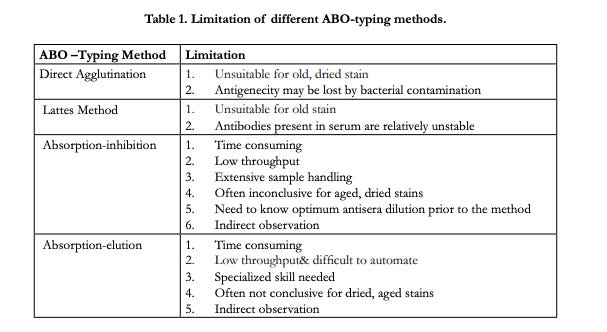
Thus, Dr. Kearse summarizes the content of this article as follows:
As recently noted by Gosh, serological methods are not suitable for older blood samples as contamination with other organisms is likely to confound the results.18
And thus summarizes the expected results on aged blood:
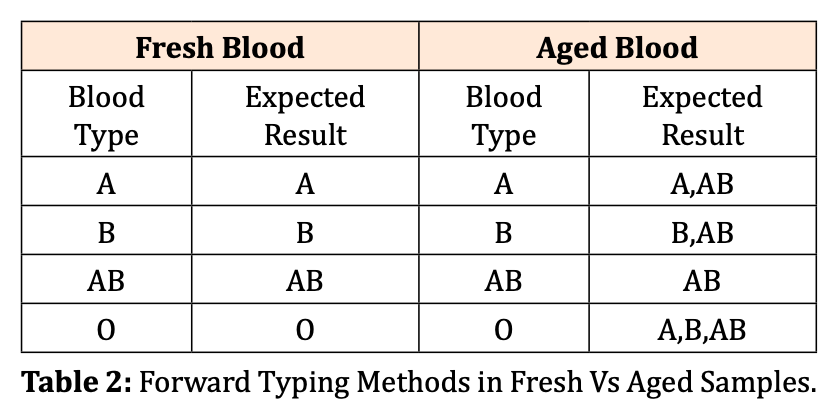
A long section of his article is devoted to arguing that the 1977 study on the Israeli skeletons did not suffer from contamination. As a reminder, following Kearse, I invoke this study in order to give an example of an exceptionally high rate of AB results that can be attributed to probable bacterial contamination. Ethan Muse judges that supposing this proportion is due to contamination is not the most probable reading of this study. As you can see, we are now in a sub-debate within the sub-debate. But it nonetheless deserves that we pause on it.
First, Ethan Muse dismisses out of hand the tables of blood-type proportions to which Kearse refers in 2023. These tables are a relevant reference because blood types are stable within a given population over time in a given region, since they are genetically determined; the burden is on whoever claims there are sudden discontinuities to prove it, and not the reverse, because transmission occurs in an autosomal codominant manner. There is no documentation of a shift in proportions within a given population, and the Jewish population is particularly renowned for its high degree of endogamy. Thus, Kearse rightly invokes a table on current proportions;
Furthermore, studies concerning the risk of bacterial contamination precisely describe several expected effects of such contamination. Among the effects mentioned are precisely the “gross deviations from the genetic equilibrium” within a population and the “high frequency of mixed reactions” such as type AB.19
A great many bacteria, fungi, and molds are known to produce aberrant results in serological tests, including false positives, and this for all methods (including the hemagglutination method used by the study in question).20 In particular, studies on the thanatomicrobiome (the bacteria in the vicinity of skeletons) have revealed that it could produce false positives.21
Moreover, even if the authors of the study on these skeletons did not detect bacterial contamination at the time of analysis (an argument also used by Dr. Linoli, who stated that he had not seen living colonies and on that ground ruled out a bacterial origin for these results), a recent study examining the blood-type analysis of bloodstains only ten years old concludes: “Based on the experimental findings, it is evident that even on samples with no visible contamination, extensive microbial colonisation can occur. Such growth can also effect the efficiency of performed tests producing false positives and negatives. This highlights the issue of necessary reformations to current practices to improve quality of investigations.”22
Thus, attributing a particularly discordant result to bacterial contamination is a sound judgment on the part of Dr. Kearse, both because it corresponds to the known effects of contamination (notably in the thanatomicrobiome) — since the proportion is indeed discordant — and because the reasons advanced by the authors of the original study (like those of Dr. Linoli) have since been shown to be insufficient. Moreover, with the absorption-elution test (the one used by Linoli), false positives have been found on bloodstains only one year old23 or even 75 days old.24 A recent study specifies, moreover, with respect to absorption-elution:
Although the ABH antigens in blood stains on cotton cloth could be detected even after 42 weeks storage by means of absorption elution methods in a previous study, we have often encountered discrepant results when determining the blood group of wet stains or putrefied bodies by the elution method. This may be ascribed to the acquired antigens or destroying of antigenicity due to bacterial contamination and/or partial digestion of erythrocytes membrane by proteolytic enzymes which exist in erythrocyte membrane. [...] The blood-stains prepared from blood samples stored for more than 60 days at room temperature showed their native blood group, but they often cross-reacted with another antibody in the absorption elution method.25
Moreover, contrary to what Ethan Muse seems to think, typing the blood of skeletal samples is actually more reliable than typing a sample like that of Lanciano. Indeed, Dr. Kearse explains in his reply to Serafini:
“Serological blood typing of ancient artifacts is particularly challenging when little to no background exists regarding the genotype of the sample in question. With articles such as skeletal remains or relatively well-preserved mummies, environmental or familial information may be available to help corroborate blood type findings. For objects like the Shroud, where bloodstains are relatively solitary in terms of typing evidence, reliability on the data is essential for confidence in the results. As each artifact is accompanied by unique and special circumstances of preservation, storage, and exposure to environmental conditions, the limitations of techniques must be determined on an individual basis. Thus, what may work for one object does not guarantee success with another.” [3] This excerpt underscores the scientific weakness in Serafini’s current reasoning. Indeed, he proposes that because certain prior studies with tissue and skeletal remains of well-preserved mummies showed promising results, this should serve to validate any future efforts with studies on unrelated materials such as religious relics and Eucharistic miracles. This is an oversimplification of the issue: each case must be considered on an individual basis as their environmental histories and physical substances are vastly different.26
2.5 Thin-layer chromatography
Muse’s objection (summarized): In Linoli’s setup, thin-layer chromatography has full probative value for identifying the material as blood.
2.5.1 What Is at Stake
This test confirms that the displayed material is, chemically, blood of some kind. The conclusion seems to me immaterial to the debate, whatever confidence is attached to it; so, rather than prolong the discussion, I simply grant the point.
2.6 Electrophoresis
Muse’s objection (summarized): The close correspondence between Linoli’s electrophoretic profile and fresh serum is evidence of extraordinary preservation; Dr. Trasancos’s reservations are merely philosophical rather than technical in character.
2.6.1 What Is at Stake
The results here are not decisive in themselves, but they could serve as a premise for the preservation argument, since they could show that the displayed blood matches the profile of fresh blood. We will return to the thesis of a miraculous preservation in a later dedicated section.
2.6.2 Response
This is the single finding on which my first article had granted the defenders their strongest concession—and it is precisely here that closer scrutiny has since obliged me to withdraw it. The profile obtained by electrophoresis in Linoli’s analysis shows, according to him, a migration of the components corresponding to that of fresh blood. This cannot serve to confirm that it is indeed blood, since that is not the object of this test, but the result remains surprising because, assuming it is blood (which we have already conceded for the sake of argument), this blood has a composition comparable to that of fresh blood, at least as regards the electrophoretic profile of the said components. Linoli offers us no other control (with degraded blood, for example) by way of comparison. Quite a few of Muse’s remarks here are common-sense and quite convincing—but he pushes them too far in his conclusion. In my article, I proposed an analogy to illustrate to the layperson how chromatography works. Ethan replaces it with another analogy intended to illustrate the improbability of the similarity observed. The problem with such a transposition is that it gives us no basis for assessing the probability of the result; it merely illustrates it with a situation that is itself improbable. An analogy is not an argument: Ethan provides no demonstration here. The illustration already presupposes the improbable character (through highly quantifiable elements); it gives no reasons to think that the profile observed by Linoli is just as improbable!
Muse then cites Dr. Trasancos’s opinion, producing the bold sentence below without the reservations accompanying it. He then asserts that Dr. Trasancos’s reservations are philosophical rather than scientific in nature—I leave the reader to judge:
« If they are run against controls, as Dr. Linoli did with human blood, the most that be concluded is that the sample could be the same as the control, although it is undeniably remarkable that the controls and tests were so close a match.
Just as in the blood typing test, electrophoresis is a first-round test that would need to be followed with more tests to know whether there were other large molecules that deposited the same way the control molecules did. The test results indicate that there are large molecules, the size of albumin, in the sample. »27
Muse uses this closeness to allege a miracle of preservation. Since a dedicated section follows below, I defer my response to it.
All of this however—Muse’s remarks, my own first article, every paragraph above—assumed that Linoli’s tabular breakdown of the blood components faithfully summarizes the curve he presents. While preparing this response, however, and after exchanges with several readers, I came to see that the figure is in fact deeply ambiguous. Indeed, an electrophoresis such as my patients can have performed today usually yields a curve like the one that follows, with 5 to 6 clearly identifiable bands.
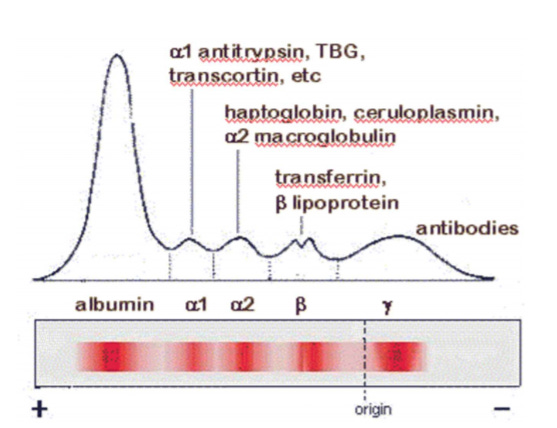
Concretely, with the agarose-gel techniques of the 1970s, a figure like this one was obtained, simply merging the C3 band and transferrin:
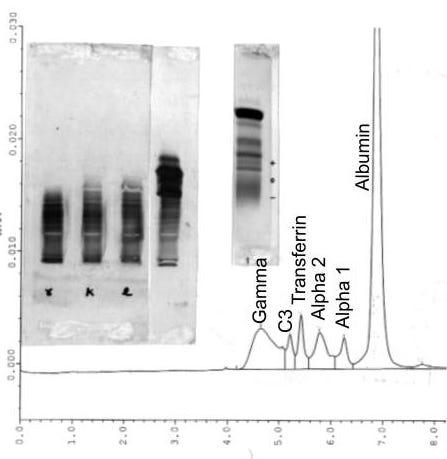
In Linoli’s study, the electrophoresis looks like this:
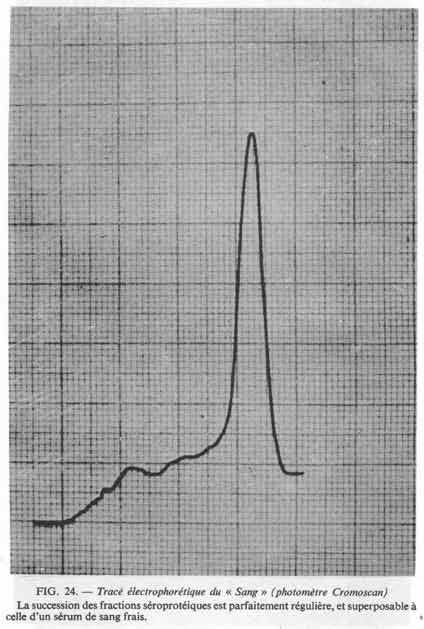
In the 1970s the albumin peak is represented on the right, hence the difference from my first diagram. What is more surprising, given what he asserts in the accompanying table, is that it does not seem possible to isolate the 4 other blood components (at that time there were 5 bands rather than 6). We do clearly see a significant peak, which would then correspond to albumin, but we see nothing else that is clearly distinct.
With no explanation of how the graph is to be read, with everything overlapping, and with no fresh-blood curve for comparison, it seems to me that the result is, in the end, simply uninterpretable. Even the cautious reading—stopping, with Dr. Trasancos, at the bare claim that a molecule of roughly albumin size is present—already says far more than Linoli is entitled to. All that can be said from this graph, which indicates no scale, is that a molecule occupies a fraction of the whole curve comparable to what albumin does in fresh blood. In other words, one cannot even assert that the molecule in question does have a size comparable to albumin. When I pointed this out to Dr. Trasancos, she confirmed to me that her book’s wording had been overly generous here. To help you visualize the matter, here is what one observes if one reproduces Linoli’s curve and places on it the fractions he indicates (I thank Mark Grant, a reader, for this composite):
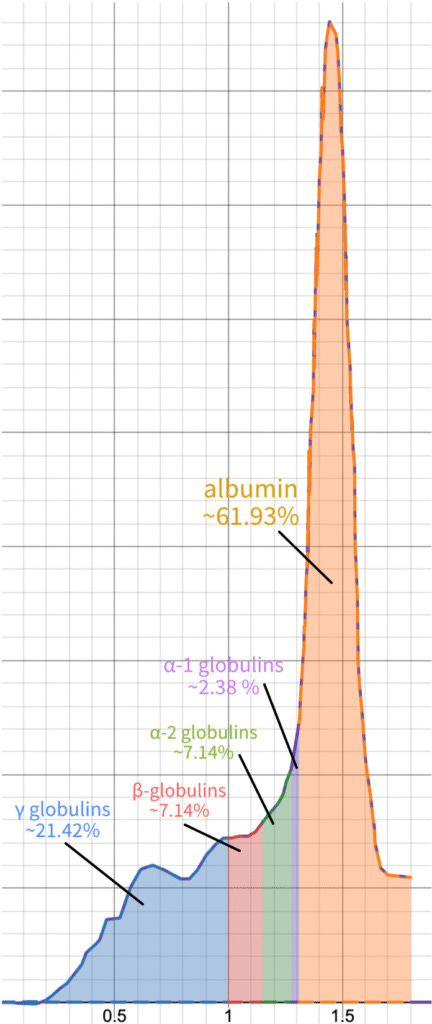
As you can see, the division of the various colored bands seems totally arbitrary. Nothing on the curve justifies this distribution. If you refer back to the diagram of a normal electrophoresis presented earlier in my article, you will see that the components are usually clearly distinct, which is not the case here.
An additional problem is that the right-hand end of the graph does not finish with a return to the baseline. In other words, there was still a deposit at that end, and it seems unreasonable to think that this deposit, had we the continuation of the curve, would stop abruptly. In other words, the fact that the curve ends abruptly indicates to us that there were other components that were not taken into account, or that accumulated at one end. If this is true, then any assertion concerning the fraction occupied by the various components becomes utterly meaningless. The addition of these various problems renders the electrophoresis data totally null. I summarize here the problems observed:
The peak that one might be tempted to identify as albumin is in reality a single, sharp, indistinct peak; a degraded sample can produce numerous migration artifacts;
It is impossible to identify and isolate the other peaks in order to provide a quantified interpretation as Linoli does in his study. In particular, there is no identifiable gamma zone or beta-globulins—a datum that a study cited by Ethan Muse in his first article reports as characteristic of aged blood.28 When the curve is fed into a software program for calculating the area under the curve, the fractions obtained do not correspond at all to those given by Linoli;
Since the last portion of the graph ends at a height, this makes it certain that the curve is truncated and does not represent the totality of the molecules present in the analyzed sample (or that an abnormal accumulation occurred at that end); this renders absolutely void any conclusion as to their relative fraction.
In short, it emerges from this examination that my first article had actually conceded far too much to Linoli by taking for granted the quantified results he presented: these figures do not correspond to the curve provided, which in turn bears no resemblance to an electrophoresis of fresh blood. These findings completely nullify Ethan Muse’s lengthy arguments based on the astonishing preservation of certain blood components, of which the graph in reality gives us no trace whatsoever. Moreover, a profile with overlapping bands that are no longer identifiable is exactly what one would expect if some of the blood components had disintegrated and others had clumped together. In other words, the profile corresponds to what one might predict in the case of degraded blood. This analysis has yet another use, in that it calls into question the quality of Linoli’s study, some of whose assertions do not seem to correspond to the results he presents—something we had already noted in our first article regarding the chemical analysis of the blood components. For some reason I do not understand, Linoli presents as corresponding to fresh blood (in quantified terms) a curve that indicates nothing of the sort; he claims that the proportion of ions is comparable to blood when it is not; and he presents as irrefutably cardiac an undifferentiated fibrous tissue. A pattern seems to emerge: the results are stretched, again and again, toward conclusions they do not support.
As a closing comment for this section, I have also contacted a hematology department in Lille in order to gather their opinion, which I will present in another article on my substack.
Part III — The Historical Case
Even if the identification were granted, the miracle thesis requires something no laboratory can supply: a reason to believe that what is displayed today was once a consecrated host. That reason can come only from the historical record, to which we now turn.
3.1 The History of Lanciano
Muse’s objection (summarized): The case for a miracle does not require the accuracy of the traditional account; and an eleventh–twelfth-century testimony reporting a double transformation in “Italy” supplies a witness earlier than the sixteenth century.
3.1.1 What Is at Stake
The Miracle of Lanciano is said to have occurred in the 8th century. Everyone agrees that several centuries separate this date from the first recorded mention of the miracle. The claim to a miracle must not only provide evidence concerning what we observe in Lanciano today, but also reasons to think that what we observe today was, at one time, a host. The reasons for thinking so rest in large part on the testimony of history—testimony that is very late and therefore does not allow one to guarantee any chain of transmission of the object over the centuries.
3.1.2 Response
Muse begins by acknowledging a central plank of my article—that any claim to the miracle depends on the reliability of the historical testimony about the relics’ origin—and then responds:
[I]t is simply not true that “one must” accept the “accuracy” of the traditional account “to conclude that a miracle occurred.” It is entirely possible that historical memory of the original miracle was corrupted over time. Maybe it didn’t involve a doubting priest. Maybe it happened in the 10th century or the 11th century rather than the 8th century. Maybe it happened during Eucharistic adoration rather than during Mass. The case for a miracle is not based on the intrinsic credibility of the historical sources that witness to the traditional account of the miracle, so it does not stand or fall with the reliability of those sources nor with the specific details they provide.
This reply completely misunderstands my point. What one must trust, in order to believe the miracle, is not this or that detail—the century, or whether the event fell during Mass (eucharistic adoration, in any case, did not yet exist in the eighth century)—but the single fact that what we observe today was once a host. This common-sense remark is offered by many commentators on the relic, including Dr. Fuso:
From a scientific point of view, it is clear that any investigation into the alleged transformation of the host and wine into flesh and blood is impossible. Belief in such a transformation is therefore a matter of pure faith. The only possible analyses concern the current state of the relic, its true nature, and methods of preservation.29
Or Dr. Trasancos:
None of the scientific investigations can prove that bread turned into flesh. They only analyze the substance at hand. Data is only as good as its weakest link, so without a verifiable eyewitness and chain of custody, the scientific tests remain inconclusive on the question of a physical and chemical substance change. It comes down to what testimony we choose to believe.30
Or Professor Casolari:
[Linoli] was certainly aware of the scientific impossibility of proving a miracle that occurred thirteen centuries earlier on the basis of materials of which nothing made it possible to establish that they were indeed those of the miracle itself.31
He notes that I claim there is no formal record of Lanciano before the sixteenth century. But I am not the first to say so: Dr. Serafini titles his own section on the history of Lanciano “an eight-century blackout.” Indeed, from the 16th century onward we have an abundance of mentions of this relic, with precise indications of the town and of the nature of the object displayed. No mention of a relic at Lanciano exists before the 16th century, any more than of a eucharistic miracle. Muse then adduces an 11th- or 12th-century testimony about a eucharistic miracle in Italy, here it is:
In Italy, a priest, while celebrating Mass, noticed real Flesh on the altar and real Blood in the chalice. At that sight, he began trembling and refrained from consuming them. At once, he reported the unusual event to his bishop and sought his advice as to what should be done. The bishop, after convening a meeting with many other bishops, recorded of the Miraculous Event and decided to take a delicate care of the chalice containing the Flesh and Blood. Eventually, everything was sealed at the centre of the altar so that all would be perpetually preserved as Extraordinary Relics.
This testimony he cites here seems rather different from what I had consulted in writing my article, and Muse (originally) provided no primary source. After some research, it appears that this text comes from a compilation produced by Father Nasuti. The primary source, according to Nasuti, is to be sought in Migne’s Patrologia Latina, volume 149, column 1428. On examining the PL, I was actually able to find the excerpt at columns 1449–1450. Muse’s purpose in producing this text is to supply the very thing I had said was missing—an attestation of the Lanciano miracle earlier than the sixteenth century—by treating Guitmund’s report as an early witness to it. The identification rests on a single load-bearing claim: that the account’s most distinctive feature, the transformation of both species, is exceedingly rare and here makes its first recorded appearance.32 “This is the earliest account of a miracle that involves the transformation of both species, an exceedingly rare feature.” Were that so, the correspondence would be hard to dismiss as coincidence. Two factors immediately tell against it, however: the excerpt fixes the locality no more precisely than “Italy,” and so licenses no formal identification with Lanciano; and it says nothing of the priest’s doubt, the classic element that frames every account of Lanciano we possess and serves as the narrative guide to its interpretation. But the most decisive problem is actually the load-bearing claim itself. The double transformation is neither the earliest nor an exceptionally rare motif, and the further correspondences Muse presses—a convened body of bishops, the species preserved as relics—are not fingerprints of Lanciano but the ordinary furniture of the genre. As the rest of this section will show, the claim is simply inaccurate.
First, it is important to recall the abundance of eucharistic-miracle stories in the Middle Ages. Besides the numerous transformations of hosts, a few of which were mentioned in my previous article, there are transformations of wine into blood: at Aachen, at Walldürn in 1330, at Fiecht in 1310, at Brussels in 1333, in Croatia in 1411, in Spain in 1231 and in 1010, in Holland in 1400 and in 1380, in Italy in 1412, at Florence in 1230; a similar story is again reported in Italy in 1718. Many of these stories likewise include a doubting priest: in other words, Lanciano does not stand out for the originality of its narrative.33 Thus, the historian François Wallerich recalls:
From the second half of the 11th century, accounts of eucharistic miracles undergo a significant development that continues until the end of the Middle Ages. The Berengarian controversy, which marks the years 1050 to 1070, constitutes a first occasion for theologians to insert miraculous accounts into their works in order to confront the peril that Berengar’s thought represents for them. In the 12th century, the rise of dissident movements that, in one way or another, call the eucharistic dogma into question likewise gives rise to a narrative production intended to confront it. But it is above all from the turn of the 12th and 13th centuries, marked by an intensification of pastoral effort, that eucharistic miracles are widely disseminated, notably through preaching to the laity, which makes extensive use of them. While the aim is always to combat heresy, it is also, more broadly, to instill in the faithful the dogma of the substantial presence and to encourage the gestures of devotion toward the sacrament that are expected both during and outside Mass. From the 13th century, most collections of exempla contain a part specifically dedicated to the Eucharist.34
Concerning the 13th century, a recent reference work on medieval miracles notes:
In addition, lay Christians took an increasing interest in new shrines housing relics linked to recognized objects of veneration, in particular those of Christ or associated with eucharistic miracles.35
The context of controversy with the Protestants that I evoked in my article as a favorable condition for the emergence of these stories contains remarkable parallels with the Berengarian controversy, which is also the context of the text cited by Ethan Muse. François Wallerich also points out that the manuscript he is studying was copied at the time of the controversy with Wycliffe to serve in a new polemical context: “Wycliffe’s name does not appear in the manuscript, but the polemical themes addressed by many texts copied therein leave no doubt.”36 The historian then continues with the medieval manuscript, the subject of his study, and states:
In most of these miracles there are individuals who deny or experience doubts regarding transubstantiation and the real presence of Christ in the host: from the priest assailed by doubt to the blind Jew, by way of the heretic, the copyist seems to have wished to gather together all the forms of challenge to the eucharistic dogma.37
This brings us precisely to the supposedly unique character of a double transformation. First, let us note that a quick search shows that in at El Cebrero in 1300, there is again mention of a priest who doubts and before whom wine becomes blood and the host becomes flesh (and this story was famous enough to inspire the coat of arms of Galicia); the miracle of Aniñón in Spain in 1300 is likewise recorded as “flesh and blood” in various chronological tables. Most pertinent to our discussion, however, if we continue reading the text of the historian I mentioned, he reports several miracles related in the manuscript in question, one of which would take place in Italy, at Mantua (the original author claims to have learned it directly from the priest in question), and which he summarizes thus:
During the Mass, a miracle occurs: the host takes on the appearance of flesh and the wine that of blood.38
And as for the aftermath of this miracle, the historian reports:
We go to find the bishop. The latter rushes to the church, consecrates other species with which he gives communion to the priest and orders that the miraculously transubstantiated host and wine be kept on the altar.39
The original author’s account concludes with:
[The species] remained thus until this day. And I myself saw them with my own eyes and I have written for the purpose of edification, with the help of our Lord Jesus Christ, to who be honor and glory forever. Amen.40
This account corresponds closely to the one Ethan Muse produces: there is no mention of a doubting priest, both species are transformed, the bishop intervenes, and the relics are preserved. The account even specifies that the relics are preserved “on the advice of the lord cardinal and bishop of Verona.”41 Thus, in both stories the bishop even takes counsel from colleagues in the episcopate. While it is highly probable that these two accounts are independent (since the one I am speaking of concerns a miracle that François Wallerich estimates occurred around the year 1300), what this shows us is how unspecific testimonies of this kind really are. Let us produce yet another testimony to make the point, that of Herbert of Clairvaux, in a text recently edited and dated to 1178:
We have also heard of a similar miracle concerning this same sacrament, but we do not know with certainty when and where it took place. While a priest of honest life was celebrating Mass on a Friday, he noticed, before communicating, that the consecrated host had taken on the appearance of flesh and that the same sacrament, in the chalice, had taken on the appearance of blood. At this sight he was seized with fear, but nevertheless received Communion faithfully. After the completion of the Mass, having revealed to his bishop what had occurred, the latter reproached him for not having reserved such a gift of God so that he himself might see it. The following Friday, however, while this priest was again celebrating Mass and the same miracle occurred, he reserved it so that his bishop might examine it. When the latter saw it, he displayed it to the sight of all, gave thanks to almighty God, and ordered that this sacrament be preserved in the church with worthy veneration, as an incomparable treasure.42
In another Liber compiling miracles, we find several other mentions of eucharistic miracles, at least one of which involves the transformation of both species; they are catalogued by Olivier Legendre in his doctoral thesis, who states: “Most Eucharistic miracles are extremely typical. A number of them relate the physical transformation of the species, which take on the consistency and taste of flesh and blood (cf. nos. 17, 31, 37, 48, 49, 53).”43 There is also the story of Aude Fauré, another “doubter/skeptic” to whom is told the story of a miracle involving a transformation of both species, according to the journal of a 14th-century inquisitor. Reading the text, one understands that this is one of the versions of the miracle in Rome, which we will discuss later in this article. Steven Justice, when presenting this case, points out that it was very popular in its time and that many similar stories circulated.44 Likewise, an edited section of a treatise by Paschasius Radbertus relates a miracle allegedly occurring under Basil (before a skeptical Jew) that involves a double transformation.45 If Muse regards the vision reported in the Apophthegmata Patrum as a relevant precedent, he must also concede that it involves both the body of a child broken and his blood collected in a cup—in other words, Muse quotes this as a case of patristic testimony about eucharistic miracles, but that goes against his original framing of Lanciano as the only double transformation of the period.
Incidentally, that the country mentioned by the source Ethan produces is Italy is in no way conclusive either; it is the country for which the largest number of eucharistic miracles has been recorded, along with Spain:46
To recap: we have no formal mention of a eucharistic miracle at Lanciano before the sixteenth century, and nothing in the account Muse provides is specific enough to force the identification. The story is, in fact, commonplace. So much so that the historian Patrick Sbalchiero, in a recent work on Catholic miracles, summarizes: “The common scenario is as follows: after a priest (or a bishop) has pronounced the words of consecration, the host and the wine contained in the chalice mysteriously change into [human] flesh and blood.”
The other elements he advances contain nothing decisive beyond the 16th century.
I therefore recall the words of Dr. Serafini in his book defending eucharistic miracles:
There are currently no reliable historical documents about the origin of these relics. The first written text explicitly mentioning a eucharistic miracle preserved in Lanciano dates back only to 1574.47
To clarify the nature of the debate, let us draw a parallel with the famous miracle of Rome, allegedly occurring under Gregory and concerning a host that is said to have transformed into a finger, which we will discuss in more detail later in the article. This miracle is said to have taken place in Rome at the end of the 6th century. Its first mention is found in a section interpolated later into a text that itself dates from the end of the 8th century. It just so happens that a church likewise claims today to present a piece of the relic, at Andechs in Germany for the devotion of the faithful. If some good doctor came to examine the relic and concluded that it was a genuine human finger, where would that lead us? To the conclusion that a mummified finger sits in a church in Germany. One may gloss as much as one likes on how surprising the matter is; that will not establish that this finger was once a host, that the transformation dates from Gregory’s time, or that there is anything miraculous about it at all.
As I close this historical section, let me recall why the argument from eight centuries of silence carries such weight: there is rich documentation on this church, and yet not once before the sixteenth century does it mention a relic. In other words, the silence surrounding this relic cannot be explained by the absence of documents about the church supposedly housing it. As Enrico Speranza and Silvano Fuso note:
Even the official act of 1258 concerning the construction of the present sanctuary, in the context of a legal dispute initiated by the Franciscans to acquire the church of Saint Legonziano, does not mention either the presence of the relics or the Eucharistic miracle itself, which is never directly cited in the various legal documents.48
Dr. Serafini has nonetheless found a way to turn this textual absence into an argument for their presence! He states, in fact, that all this rich documentation testifies to an interest in this church and its “precious, though never mentioned, contents.” It seems that there is truly not a single unfavorable element that cannot be cleverly reframed by our apologists.
3.2 Anachronism
Muse’s objection (summarized): A statistical chart of Eucharistic-miracle accounts shows that neither the “doubting priest” motif nor the relic’s physical features is anachronistic for an eighth-century origin.
3.2.1 What Is at Stake
This section extends the previous one: several features of the Lanciano account, and of the displayed objects themselves, are anachronistic on the assumption of an eighth-century origin. What is at issue, once more, is the reliability of the historical testimony.
3.2.2 Response
In my first article, I provided an excerpt from the Ecclesiastical History of the Franks to point out that a eucharistic miracle in antiquity was not necessarily perceived as an argument for a particular understanding of the Lord’s Supper. Ethan Muse recalls the well-known episode of the transformation of consecrated bread into a finger in a hagiography of Saint Gregory (the famous miracle of Rome), dating from the end of the 8th century, as a precedent for a eucharistic miracle understood as confirmatory of the real presence. The difficulty with this argument is that sections 23 to 28 of the life of Gregory (that is, those reporting his miracles) are today regarded as a later interpolation by a pious copyist.49 It just so happens that in other research, I have argued for a 9th-century origin of such an understanding, with Paschasius Radbertus, but that digression would take us too far afield. The point remains that I do not regard this testimony as probative, since it is of later origin. He further advances a text from the Apophthegmata Patrum, which speaks not of a miracle of eucharistic transformation but relates a vision of an angel feeding a man with bloody flesh. The nature of the text is nonetheless appreciably different. But above all, there are few texts as well known for their interpolations, false attributions, and difficult dating as this collection of varied sayings of the Fathers. It is a collection known in various recensions that would fix in Greek the sayings of Eastern fathers. Roger Pearse explains well in this article the difficulty the historian encounters with these texts. Thus, my point remains valid: the closest precedent we have for a transformation of the consecrated elements into bloody matter at the time when the miracle of Lanciano is supposed to occur consists of transformations that are not interpreted as corroborating the Real Presence but as foretelling misfortune. This argument is in no way decisive, mainly because by the end of the 9th century one can find legends interpreted in this way, but it deserved a passing mention.
Ethan Muse then offers an entirely specious argument. First, he claims that a graph he presents (see below) shows the “doubting person” motif to have been more frequent in antiquity than in the Middle Ages. The graph shows the exact opposite: there are only two cases in antiquity on this graph, against a good dozen in the Middle Ages. Moreover, the one who produced this graph comments on this himself in his introductory article, stating: “Sorry Ethan, but it seems like the Doubter stories are likely a figment of medieval imagination, for a variety of reasons.”
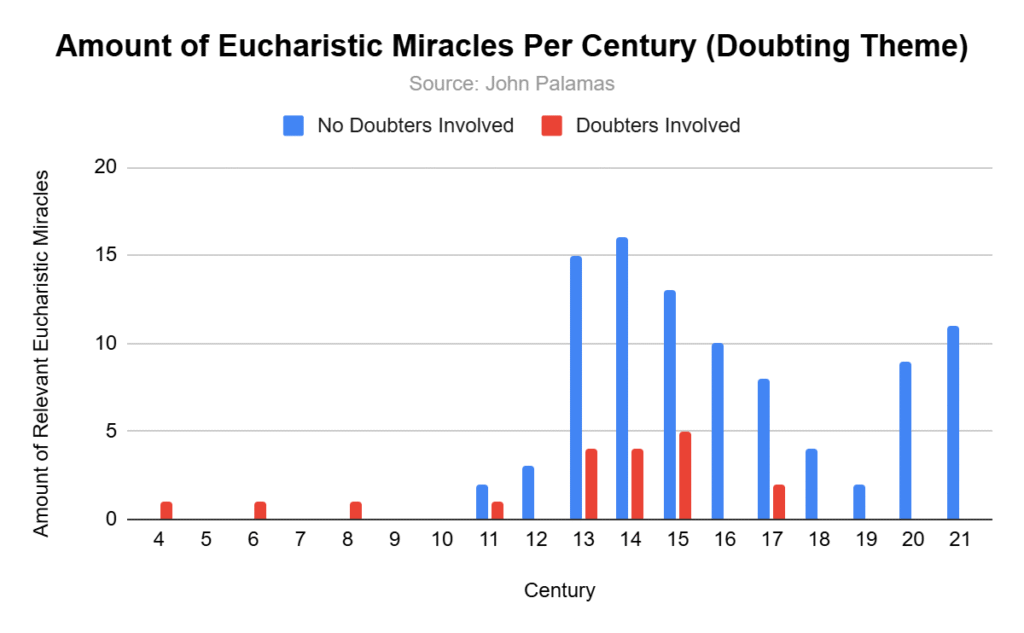
Furthermore, it is crucial to understand that this chart doesn’t list the earliest mentions of these miracles, but rather their alleged dates. A miracle mentioned in the 17th century but whose account places its origin in the 11th century would therefore be placed in the 11th century, even though we have no record of that miracle from that period. Thus, Lanciano will be placed in the 8th century on the graph (and, I suppose, Gregory’s miracle during his lifetime, and perhaps the vision we spoke of in the 4th century, since the author based himself on this catalogue of eucharistic miracles), whereas we have no record of them from that time. This renders Muse’s analysis completely invalid, since my point is that there was a particular interest in the 16th century in this kind of miracle, and not that these miracles were alleged to have occurred at that time—and this independently of the presence of a “doubting subject.” A eucharistic miracle can be used in 16th-century controversies without there being any question of a doubting subject; this digression, besides being erroneous, therefore has little connection with my argument.50
In my article I point out that leavened bread was still widely used in the eighth century, before its replacement by large unleavened wafers. Muse simply passes over the sources I cite without interaction—among them Father Jungmann, who comments on the very text Muse invokes:
Closely linked to this gradual disappearance of the sacrament from all phases of daily life was a transformation in the type of bread used, namely the shift to unleavened bread. Alcuin and his pupil Rabanus Maurus are the first undisputed witnesses to this new practice, which then spread very slowly. The increased emphasis placed on the sacrament probably favored the introduction of pure hosts, which could be much more easily broken without having to worry about crumbs.51
Moreover, Muse provides absolutely no source to dispute the appearance of thin hosts before the 11th century, and merely asserts that the Lanciano relic is considerably wider than an 11th-century host—a gratuitous claim advanced, again, without a source. Here, as a reminder, is what the Catholic Encyclopedia referenced in my article says about this 11th century appearance:
The earliest documentary evidence that the altar-breads were made in thin wafers is the answer which Cardinal Humbert, legate of St. Leo IX, made at the middle of the eleventh century to Michael Cerularius, Patriarch of Constantinople.
3.3 The Analogy of the Prophecies
Muse’s objection (summarized): The analogy between Lanciano and the three Protestant prophecies commits a category error, since the prophecies rest on reports of remembered wording while Lanciano rests on physical artifacts.
3.3.1 Response
Ethan Muse next takes up the three prophecies I had offered as examples of supernatural claims whose documentation stands closer to the events they report. His reply, which bizarrely devotes considerable space to portraying Luther as a habitual liar, rests on a complete misreading of the comparison’s purpose. My argument was very simple (though woefully misunderstood by Muse): my point was never that these prophecies constitute better-attested miracles than Lanciano; it concerned strictly the documentary strength of a testimony—how close the surviving record stands to the event it relates. If this analogy does not please him, let us substitute for it that of the miracle of Rome that I mentioned earlier. Because Muse reframes the comparison as a claim about the relative overall credibility of the miracles, his charge of a “category error” misfires: it answers an argument I did not advance. Being that he so badly butchered my argument, there is no need to respond to him further on this point; I simply invite the reader to consult my original article.
That being said, since Muse has announced his future intention to paint a pejorative portrait of the famous German monk—thinking thereby to discredit Protestantism—it is worth addressing the assumption underlying his little excursus. Muse appears to treat Protestantism as a religion founded by a single charismatic figure—at one point likening it to a restorationism such as Mormonism, dependent on a founding prophet—so that to discredit Luther would be to discredit the movement. This mistakes the nature of the Reformation, which was not the achievement of one German monk but the joint work of hundreds of churchmen across Europe, of magistrates, and of countless laypeople. The indulgence controversy in which Luther figured served as a catalyst, not as the foundation of the movement. One might add, for perspective, that seven years before the Ninety-Five Theses Pope Julius II died of syphilis; I am not certain that a comparison of the character of the Roman pastors and the Protestant pastors of that era would turn out to Muse’s advantage. For any specific charges levelled against Luther, I refer readers to this page, which refutes most of the common slanders about Luther. Dear Ethan, we eagerly await the remainder of your case!
3.4 The Origin of the Relic
Muse’s objection (summarized): A pre-modern forgery is wildly implausible, given the difficulty of procuring and preparing human cardiac tissue and the improbability that a forger would produce so anatomically faithful an object.
3.4.1 What Is at Stake
This section takes up the arguments for the implausibility of a fraud.
3.4.2 Response
The arguments against a fraud that Muse presents are nothing new; they presuppose the rest of his—highly questionable—case. Indeed, the argument for the implausibility of a medieval fraud rests on (1) the identification with the human species, (2) the identification of the relic as cardiac tissue, (3) the fact that the relic’s cavity is original and not due to retraction, (4) the supposedly laminar character of the section, and (5) various conjectures about what might have motivated a medieval forger. The argument loses its force as each of these various points becomes uncertain; in effect, then, it has already been answered, point by point, above.
If, however, the reader (somehow) remained convinced that it was a human heart, that does not suffice to establish the improbability of a fraud. The manufacture of a false relic is, after all, in no way far-fetched a priori: it is a documented thing, frequent in the medieval period and in the centuries that followed. There have been hundreds of false relics, as the sources produced in my first article attest. Moreover, while I was recently visiting the Arkéos museum in Douai with my children (an experience I recommend!), I was able to see a heart reliquary in their exhibition. This relic was accompanied by the following text:
In the Middle Ages, it sometimes happened that the deceased expressed the wish that their body, or only their heart, be buried in a place dear to them.
The text continues regarding the relic displayed, a heart found in a metal box in the parish church of Saint-Jacques, beneath the bottom of a tomb located in the choir, which is said to have belonged to Anne de Lens, the wife of Adrien de Dion, the governor of Louvain, who died in 1580. It was not exceptional to remove this particular organ from a human body precisely in order to preserve it as a relic.
Part IV — The Argument from Preservation
4.1 Preservation
Muse’s objection (summarized): No “law of miracles” requires preservation to be perfect.
4.1.1 What Is at Stake
Catholic apologists claim there is a miracle within the miracle: the relic is said to be miraculously preserved.
4.1.2 Response
Throughout the examination of the Lanciano relic, whenever a result appears surprising to our apologists, they present it as proof of miraculous preservation. And whenever a result one would be entitled to expect is absent, they invoke the age of the relic. When I object that it makes no sense to invoke miraculous preservation and then, when convenient, play the card of poor preservation, Muse replies that he sees no reason such a “law of miracles” should hold.
Before responding directly to his point about the law of miracles and to the analogies he provides, let us recall that the only surprising element we had conceded regarding preservation in our first article is the electrophoresis profile (and we indicated above how far the interpretation of the graph was actually conceded rather than established: I simply do not know how Linoli isolates five bands on his graph, which bears no resemblance at all to an ordinary electrophoresis). By contrast, poor preservation is invoked by Linoli and his disciples for (1) the abnormal levels of various chemical compounds, (2) the absence of nuclei in the histological sections, (3) the uniform appearance on these same sections, (4) the non-reactivity to the Teichmann test, (5) the non-reactivity to the Takayama test, (6) the absence of red and white blood cells, (7) the absence of the interventricular septum in the macroscopic appearance, (8) the presence of mold, etc.
Having clarified this, let me remind Muse that the Roman communion has in fact laid down “laws” concerning miracles. Not, to be sure, laws relating to what God may be pleased to do miraculously (after all, if God wishes to make a sick person only somewhat less sick rather than to heal them entirely, He can do so). But Rome has stated laws for our recognition of what counts as a miracle. Indeed, in 1735, Cardinal Lambertini, who would later become Pope Benedict XIV, listed five criteria for identifying healing miracles. He observed that the healing miracles reported in the Gospels generally exhibited these five characteristics:
The healing was complete. The deaf man did not need to cup his hand to his ear, saying, “Could you speak louder?”, nor did the paralyzed man, as far as we know, hobble away leaning on a friend’s arm, requiring someone else to carry his bed.
The disease was incurable (such as congenital blindness, kyphosis of the spine, an atrophied arm, paralyzed legs, or a death four days old);
The conditions were generally non-remitting (with the exceptions of epilepsy and menorrhagia). Most could not resolve spontaneously;
The healing was instantaneous, most often following a word of command. Two Gospel examples mention a very short delay before completion, but otherwise they are all reported as occurring “immediately”;
No other therapy could account for the recovery. Saliva and mud applied to the eyes would not, in themselves, have any therapeutic effect.
Once again, these rules do not intend to set limits on what God can do, but to identify the criteria that allow us humans to recognize that a miracle has actually taken place.
Muse believes he finds an analogy to this partial preservation of the relic in the fact that the glorified body of our Lord retained the marks of His wounds, or that Lazarus died again after being raised. I leave it to each reader to weigh the force of these considerations: it seems manifest to me that the resurrection of a dead person and a surprising electrophoresis result (once again, assuming it is even valid) are incomparable when considered from the standpoint of our ability to recognize in them the hand of God. For my part, I maintain that to speak of a miraculously preserved relic, it is not enough that one component of the blood be preserved and another not. If he will allow me to spin out his analogy, the miracle he alleges would be comparable to a person with a skin disease over their entire body who suddenly healed in a few places, while remaining in poor overall condition. This is perhaps surprising, but insufficient to speak of a miracle. And it does not meet the criteria adopted for miraculous healings, which are, moreover, rarely satisfied at Lourdes.
Everything that follows in his argument is an exploration of how an exceptional preservation might be explained—a preservation I see no reason to posit in the first place. Once again, his case rests largely on the famous electrophoresis bands that I am unable to isolate on Linoli’s graph.
He then notes that a quotation from Silvano Fuso is incorrectly represented in my article. The point is fair, and I will correct my article accordingly; here is the full quotation (with the parts omitted in my article in bold):
Of course, the preservation of proteins and minerals observed in Lanciano’s flesh and blood is neither impossible nor exceptional: repeated analyses have allowed proteins to be found in 4- and 5,000-year-old Egyptian mummies. But it should be emphasized that the case of a body mummified according to known procedures is very different from that of a fragment of myocardium, left in its natural state for centuries, exposed to atmospheric physical and biochemical agents.
But Muse, in turn, omits what follows in the quotation—material that did appear in my article:
Unfortunately, Professor Linoli’s studies leave many questions unanswered. For example, they provide no information on the age of the relic and do not completely exclude the possibility that an anatomical specimen could have been naturally preserved under these conditions, even without added preservatives.52
Professor Fuso reiterated this view in a chapter of a book on miracles devoted to Lanciano and co-written with Enrico Speranza:
Many “natural mummies” have formed through simple tissue dehydration, thanks to particularly hot and dry climates. The analyses, in the case of Lanciano, should therefore not completely exclude the possibility that an anatomical specimen was naturally preserved under these conditions, even without the addition of preservative substances. Likewise, Linoli’s assertion concerning the impossibility of preserving blood once dried should be supported by experimental evidence or scientific references in order to be more convincing (dried ox blood is sold as fertilizer for houseplants, and it keeps for years in that state).53
Thus, while Muse is quite right to point out that the nuance omitted from my article is important (and that I should therefore have left it in: mea culpa), it must be recalled that this nuance qualifies a conclusion that I did not misrepresent: Dr. Silvano Fuso does not rule out the possibility that the Lanciano relics were preserved naturally under these conditions without the addition of preservatives. Dr. Fuso’s two remarks are exactly parallel to mine, namely that one should ascertain the age of what is being examined before drawing any conclusions about its preservation, and that it is not impossible that what we are observing could be the result of a natural process. The way my quotation is truncated is comparable to what he did with Dr. Trasancos’s quotation on electrophoresis, with the difference that he falsely added that her reasons for objecting were philosophical, whereas she continues with a purely scientific and factual argument. It is also fairly comparable to his summary of Professor Budetta’s remarks or of Gosh’s article (2022). My point is not to insinuate that Muse deliberately lied to his audience, but to note that poorly truncated quotations are something that simply happens, especially in articles tens of thousands of words long, and that this can be read with charity rather than suspicion.
He uses this inaccuracy to question my integrity. One understands between the lines that he is here seeking to avenge Dr. Linoli: you dared to suspect him, I will do the same. All this is rather childish, but I’ll let it pass; I have already proposed a remedy to this objection. It suffices for his friend (and mine), Matthieu Lavagna, to stop by my home—whose address he knows—and take the time to read for himself the email exchange with my professor, whose name he will keep to himself. I trust the reader, moreover, to assess the difference between a forged report fabricated out of whole cloth, which had to be deliberately written by somebody, and a poorly abbreviated quotation in a 40,000-word article. Since we are on the subject of personal grievances, Muse reproaches me for prefacing one of my remarks with the fact that he is a philosopher and not a physician. I concede that this remark unnecessarily shifts the discussion onto personal rather than reasoned arguments; he is right to judge it of little relevance. Let us therefore return to the argumentative considerations. Dr. Fuso’s remarks are comparable to those of the professor of biology Antonio Casolari:
The absence of preservatives in the relics has not been properly demonstrated, due to a lack of adequate microbiological analyses.54
And as Casolari comments on the WHO report (whose falsity had not yet been established at the time his article was written):
The conclusions attributed to this commission moreover assert that the relics could be preserved neither naturally nor artificially, which is manifestly false: dehydration is a well-known natural preservation process.55
Muse further criticizes my appeal to mummies preserved in very stable conditions, alleging that these are different preservation situations. This is true. It is also true that the quality of the preservation is markedly superior. In other words, it would indeed be surprising for Lanciano to be as well preserved as these mummies, since their environment is more stable—but the Flesh of Lanciano is much less well preserved. Notice, too, that Muse avoids commenting on the presence of soft tissue in dinosaur bones or on Neolithic tools; I will not dwell on these points, but I remind the reader that finding a red blood cell in a bone as ancient as that of a dinosaur, or on ancient tools, is a far more astonishing preservation than the one concerning the electrophoresis profile (which, let us recall, in reality seems to correspond to the profile expected for poorly preserved blood!), and it was on that account that I cited them.
Conclusion: Key Takeaways
The granular discussion above risks obscuring the larger picture, so let me restate the points that matter most—none of which Muse’s response overturns:
First, there is a gap of several centuries between the alleged date of the miracle and its first known mention. Yet belief in the Lanciano miracle depends on what we observe today having once been a host. My anachronism argument—turning on the size of the host—drew no significant response from Muse, and the eleventh-century testimony he produces is entirely unremarkable;
Secondly, Linoli’s histological interpretation, which is a flagship argument of the miraculous thesis, is not established. It is difficult to obtain the opinion of histologists, and still more to obtain their agreement to have their name appear in the midst of such a controversy. After contacting more than 30 of them, only three replied to me: my professor; a second who at first indicated his agreement and then no longer replied, and whom I do not dare to pester with follow-up emails; and finally the one I mentioned in the present article. I have not, however, exhausted my contacts, and I remain hopeful of providing new analyses.
The information we have on Lanciano does not allow us to rule out bacterial contamination as the cause of some of the results we have obtained. This is the judgment of authors far more qualified to draw conclusions in this area than Muse or myself.
The single strongest datum in Muse’s preservation argument—the electrophoresis—itself turns out, on inspection, to be quite dubious.
Linoli’s study is subject to bias due to several factors: firstly, the protocol was conducted without proper oversight and controls; secondly, Linoli was commissioned by the convent; thirdly, he believed before the investigation that what he was about to observe was of miraculous origin. Traces of that bias surface in his histological conclusions, his summary of the electrophoresis, and his chemical analyses—to say nothing of the still-unsolved fraud surrounding the study.
A good number of our disagreements could easily be settled by a quality, controlled study.
In short, having spent further time on the question, I find the miracle thesis even shakier than I judged it in my first article. Nothing in the available data warrants the conclusion that a miracle occurred.
Postscript: A Reply to Dr. Serafini
For the rest, I am astonished that this subject is treated with such animosity by the defenders of the miracle. By everyone’s admission, a Catholic may not believe in this miracle. Why, then, treat objections as if they were a form of culpable unbelief?
By way of anecdote, I would like to mention an entirely personal case. A member of my family has celiac disease. This disease is not a matter of a probable diagnosis but is established by biopsies. This condition causes this close relative of mine to have a total intolerance to gluten. One day, while cooking, she inadvertently brought a grain of flour to her mouth, thinking it was a grain of sugar. This exposure was followed by a sharp reaction matching the symptoms of the disease. Yet, this person regularly receives communion in her Protestant parish and takes leavened bread there containing a normal (that is, quite high) quantity of gluten, without suffering any reaction. This situation undoubtedly astonishes me, being the physician that I am. Is that nonetheless sufficient to speak of a miracle? Must I cast doubt on the faith of those who would not subscribe to this conclusion?
I am indeed keen to address an excerpt from an article by Dr. Serafini, in which he states, concerning me:
He is a doctor, but he is also a Protestant, and for some time now, he has embarked on the reckless adventure of discrediting all Catholic Eucharistic miracles. I feel some sympathy for him and respect his courage and honesty in admitting that he is the bearer of a blinding bias. The slightest spark of scientific truth linked to a Eucharistic miracle would be fatal to his Evangelical faith (for us Catholics, conversely, even if all the Eucharistic miracles in the world were false, this would not change our faith in the Real Presence one iota). Best wishes, Dr. Georgel!
This assertion is completely false, and had been anticipated in my article of general considerations on eucharistic miracles, in which I explain the three options available to a Protestant faced with an allegation of a eucharistic miracle. Among these options, two of them involve recognizing a supernatural phenomenon without conceding the truth of Catholicism. This proposal should not surprise Dr. Serafini, since he himself asserts in his book, concerning certain dubious mystical phenomena (including the transformation of the host into bloody matter in the case of the mystic Julia Kim):
This question of factitious mystical phenomena, or truly inexplicable ones—whose origins may be, and probably are, diabolical—is certainly interesting, though it would warrant an in-depth discussion that I will not undertake here.56
To reject this hypothesis on principle here would amount to an unjustifiable double standard. Finally, I would also like to remind him that I too believe in the real presence.
Postscript II: Am I a Skeptic?
Muse introduced his series on Catholic miracles by claiming to provide an argument capable of convincing the skeptic. That said, I am a Christian. I am therefore among those who think that miracles are not only possible but that several have already occurred. Since (at the time of writing) we have just celebrated Easter, it may be interesting to compare the miracle of the resurrection with the one we are studying. I have been charged with arguing against Lanciano exactly as a skeptic would argue against the resurrection—as though the evidence were equally solid on both sides. Here is my reply:
The first witnesses of the resurrection had nothing to gain by lying about it. Even if one were to doubt the historicity of their martyrdom, which is unreasonable in the case of Paul , James and Peter, one must concede that they were at least prepared to endure suffering to that extent for their testimony. To suspect the apostles of dishonesty is a far more perilous assertion than to suggest bias on the part of a single doctor commissioned by a monastery;
The quality of what is observed differs as well. One needs no particular scientific competence or rigorous protocol to ascertain that a person is alive and in good health, and to recognize their identity if one has spent several years in their company. This observation being more direct and simple to establish, it is far less liable to errors of judgment than immunological-chemical-histological analyses;
The documentation for establishing the miracle is more plausible. For both these miracles, it is not enough to establish that Jesus was seen alive in one case, or that it is a human heart in the other. One must also establish that Jesus had first been dead in one case, and that it was once a host in the other. Now, while the witnesses of the resurrection have no trouble knowing that Jesus had been executed, we who are the present-day witnesses for this relic have far more trouble establishing the origin of what we observe. Thus, the fact that we have testimonies close enough for even skeptical authors to concede that the resurrection story began within a few years of Christ’s death is a situation very different from the first traces, some centuries later, concerning the alleged origin of the relic;
The nature of the miracle differs again. (A) However astonishing one may find it that a piece of human flesh could be in a reliquary, one must admit that this is a result markedly easier to produce than to present alive a man whose execution was publicly carried out. (B) Even if it were a matter of establishing the supernatural origin of these two events, it is manifest that God alone raises the dead, whereas the displacement or the changing of one body into another is an effect also attributed to demonic actions in the Bible;
The resurrection was falsifiable at the moment it was proclaimed: it sufficed to produce the body. The apostles’ adversaries never attempted this, which is a remarkable indicator. For the miraculous preservation of Lanciano, by contrast, things are different: the argument in favor of miraculous preservation is non-falsifiable by construction. Good results confirm the miracle; bad results are explained by the age of the relic. (We have detailed this point in the body of the article.);
The plausibility of the miracle relative to prior revelation is also very different. While one can mention prophecies foretelling that a man, after having given his soul as a guilt offering, “will prolong his days” (Isaiah 53) and that God would not leave His Holy One in the tomb (Psalm 16), and while the third day was also associated with the resurrection, we have no scriptural indication that the true Church will recognize itself in the future by miraculous signs involving bloody bread and the like. Miracles served to establish the ministry of those who delivered to us the faith “once for all” (Jude). The only post-apostolic miraculous signs that the New Testament mentions are those of the false prophets.
Thus, I do not reject the Lanciano miracle because I would be a skeptic on principle about miracles simpliciter, but because I apply the same criteria to a different case—and because my biblical theology obliges me to be particularly vigilant regarding post-apostolic signs, which Scripture itself invites me to examine with care.
“Instead of meditating on the life [of the apostles, martyrs, and other saints] in order to follow their example, [the world] has put all its study into contemplating and treasuring their bones, shirts, belts, caps, and similar rubbish. What a sacrilege it is, thus to abuse the name of Jesus Christ in order to cover over fables so coldly forged! So it is with relics: everything is so muddled and confused that one cannot worship the bones of a martyr without being in danger of worshipping the bones of some brigand or thief, or indeed of a donkey, a dog, or a horse. One cannot worship a ring of Our Lady, or a comb of hers, or a belt, without being in danger of worshipping the trinkets of some harlot. The main thing would be to abolish among us Christians this pagan superstition of canonizing relics, both those of Jesus Christ and those of His saints, so as to make idols of them.”
— John Calvin, Treatise on Relics.
“Having finished these words, as the brethren wished to compel him by their prayers to remain with them for the end of his life, he refused for several reasons that his very silence made manifest. The principal one was this: The Egyptians bury and wrap in quantities of linen the bodies of persons who die in piety, particularly those of the holy martyrs. And instead of burying them, they place them on small beds and keep them thus in their houses, believing they render them great honor. On this point, Anthony had often begged the bishops to instruct their peoples so as to draw them out of this error. He had also shamed many of the laity over it and had sharply rebuked some women, showing them that this was in keeping neither with the laws nor with piety, since even today the bodies of the patriarchs and the prophets are kept in tombs. Even the body of our Lord had been placed in a tomb, and a stone had been rolled to the entrance to close it until He rose on the third day. Thus he made known to them that one cannot, without fault, fail to bury the bodies of the dead, however holy they may be, since there is nothing greater or holier than the body of our Lord. And his discourses had such force that many of those who heard them thereafter buried their dead and gave thanks to God for the instruction Anthony had given them. It was therefore chiefly out of fear that superstitious honors—such as he had seen rendered to others—might be rendered to his body that he hastened to return after taking leave of the solitaries.”
— Saint Athanasius, Life of Saint Anthony, chapter XXXI.
Translator’s note. A few items require context for the English reader. (1) Proper names and titles of Italian, Latin, French, and German scholarly works have been left in their original language per standard academic practice, with a bracketed English gloss only where helpful (e.g., Serafini’s book). (2) biais de prévarication has been rendered throughout as “prevarication bias” (the bias arising when an investigator both collects and analyses the data without independent oversight); Lecture Critique d’Articles as “Critical Appraisal of Articles,” the standard French medical-curriculum subject.
P.S.: In preparing this article, I (Maxime) took many additional notes related to secondary arguments. If you would like access to them, feel free to contact me.
*Updates/edits:
For our other articles on this topic, see:


Kearse K, Ligaj F., Scientific Analysis of Eucharistic Miracles: Importance of a Standardization in Evaluation . J Forensic Sci Res. 2024; 8(1): 078-088.
Silvano Fuso and Enrico Speranza, “Il miraculo eucharistico de Lanciano” in In cerca di miracoli , I Quaderni di CICAP, 2009, page 78.
Franco Serafini, A Cardiologist Meets Jesus, Kindle edition.
Antonio Casolari, Le indagini eseguite dal prof. O. Linoli (1970-71) per rendere credibile il ‘miracolo eucaristico di Lanciano’ sono del tutto prive di qualunque valore scientifico.
Ibid.
Franco Serafini, Un cardiologue rencontre Jésus [A Cardiologist Examines Jesus], Kindle edition.
Antonio Casolari, Le indagini eseguite dal prof. O. Linoli (1970-71) per rendere credibile il ‘miracolo eucaristico di Lanciano’ sono del tutto prive di qualunque valore scientifico.
Page 223 of this Sourcebook in Forensic Serology, Immunology, and Biochemistry
Page 222 of this document.
Page 224 of this document.
Page 223 of this document.
Kearse K, Ligaj F., Scientific Analysis of Eucharistic Miracles: Importance of a Standardization in Evaluation. J Forensic Sci Res. 2024; 8(1): 078-088, p. 79.
Cited in Thomas W. Case, The Shroud of Turin and the C-14 Dating Fiasco: A Scientific Detective Story, Cincinnati, White Horse Press, 1996, p. 56.
Gosh S. ABO Typing in Forensic Analysis: to be or not to be in the epoch of genotyping. International Journal of Forensic Science & Pathology (IJFP). 2022;9(3):487-494.
Gosh S. ABO Typing in Forensic Analysis: to be or not to be in the epoch of genotyping. International Journal of Forensic Science & Pathology (IJFP). 2022;9(3), p. 494.
Kearse Kelly, Inadequacies in Serological ABO Typing of Ancient Artifacts, International Journal of Forensic Sciences, 2023.
BORGOGNINI TARLI, Silvana, PAOLI, Giorgio, and FRANCALACCI, Paolo, “Problems and perspectives in palaeoserology,” in Anthropologischer Anzeiger, December 1986.
Springer GF, Horton RE. Blood group isoantibody stimulation in man by feeding blood group-active bacteria. J Clin Invest 1969;48:1280–1291; Springer GF, Williamson P, Brandes WC. Blood group activity of gram-negative bacteria. J Exp Med 1961;113:1077–1093; Spalter SH, Kaveri SV, Bonnin E, Mani JC, Cartron JP, et al. Normal human serum contains natural antibodies reactive with autologous ABO blood group antigens. Blood. 1999;93(12):4418-4424; Van Oss CJ. Letter to the Editor: Natural versus Regular Antibodies. The Protein Journal. 2004;23:357; Hooft P, Van de Voorde H, Van Dijck P. Bloodgroup simulating activity in aerobic gram negative oral bacteria cultured from fresh corpses. Forensic Science International. 2004;50(2):263-268; Hart GV. Blood group testing of ancient materia. Masca J. 1980;1:141-145.
Chakraborti S, Ghosh S. Bridging the gap: Exploring the microbial influence on forensic ABO typing discrepancies for enhanced investigative accuracy. Forensic Sci Int. 2024;365:112284.
Pavitra Shanmugam, Ritika Roy, Jaya Sethi. Impact of age and microbial growth on the accuracy of preliminary tests and blood grouping of dried blood stains in forensic investigations. Indian Internet Journal of Forensic Medicine & Toxicology. 2015;13(4):86-91.
Açikgöz H N. Blood Group Detection by Absorption-Inhibition and Absorption-Elution Methods from Blood Stains on Stone. J Forensic Sci & Criminal Inves. 2018;10(3):555788.
Açıkgöz N, Kendir Ö, Bilge Y. Kan lekelerine etki eden çevresel faktörler [Effects of environmental factors on blood stains]. Ankara Üniversitesi Hukuk Fakültesi Dergisi. 2007;56(3):1-10.
Nishi K, Rand S, Nakagawa T, Yamamoto A, Yamasaki S, Yamamoto Y, Kobayashi A, Kane M, Morimoto A, Spalthoff H, Annuss B. ABO blood typing from forensic materials: merits and demerits of detection methods utilized in our laboratories, and biological significance of the antigens. Anil Aggrawal’s Internet Journal of Forensic Medicine and Toxicology 2005;6(2).
Kearse K.P., Scientific analysis of shared AB blood type among relics and eucharistic miracles: A reply to Franco Serafini’s commentary. Forensic Sci Med Pathol, April 2025.
Trasancos Stacy, Behold it is I.
Rajamannar, V. (1977). Determination of the age of bloodstains using immunoelectrophoresis. Journal of Forensic Sciences, 22(3), 396–402. Washington, D.C.: American Academy of Forensic Sciences.
Fuso S, Il miracolo eucaristico di Lanciano, CICAP, 2006.
Trasancos Stacy, Behold it is I.
Antonio Casolari, Le indagini eseguite dal prof. O. Linoli (1970-71) per rendere credibile il ‘miracolo eucaristico di Lanciano’ sono del tutto prive di qualunque valore scientifico.
In the first version of his article, Muse actually said that that the transformation of both species was unique to Lanciano. In other words, Lanciano was framed as the only case of double transformation in that period; Muse modified this framing in his article (and indicates at the end of his article that the modification was made because of the French version of my article).
Wallerich, François. “Miracles eucharistiques et prêtres indignes dans quelques recueils cisterciens (1170-1220).” Revue d’histoire de l’Église de France, t. 101, no. 246 (2015), pp. 19-40; Caesarius of Heisterbach. The dialogue on miracles. Vol. 2. Trans. Pepin RE. Collegeville, MN: Liturgical Press; 2023.
Wallerich F. Des cathares aux lollards. Des miracles eucharistiques inédits dans l’Angleterre du XVe siècle. Revue Mabillon. 2018, pp. 189-190.
Katajala-Peltomaa S, Kuuliala J, McCleery I, eds. A companion to medieval miracle collections. Leiden: Brill; 2021, p. 167.
Wallerich F. Des cathares aux lollards. Des miracles eucharistiques inédits dans l’Angleterre du XVe siècle. Revue Mabillon. 2018, pp. 200-201.
Wallerich F. Des cathares aux lollards. Des miracles eucharistiques inédits dans l’Angleterre du XVe siècle. Revue Mabillon. 2018, p. 191.
Wallerich F. Des cathares aux lollards. Des miracles eucharistiques inédits dans l’Angleterre du XVe siècle. Revue Mabillon. 2018, p. 192.
Wallerich F. Des cathares aux lollards. Des miracles eucharistiques inédits dans l’Angleterre du XVe siècle. Revue Mabillon. 2018, p. 192.
Wallerich F. Des cathares aux lollards. Des miracles eucharistiques inédits dans l’Angleterre du XVe siècle. Revue Mabillon. 2018, p. 211.
Wallerich F. Des cathares aux lollards. Des miracles eucharistiques inédits dans l’Angleterre du XVe siècle. Revue Mabillon. 2018, p. 192.
Herbertus Claraevallensis, Liber visionum et miraculorum Clarevallensium, ed. Giancarlo Zichi, Graziano Fois and Stefano Mula, Turnhout, 2017, Corpus christianorum. Continuatio mediaevalis, 277, p. 171.
Legendre O. Le Liber visionum et miraculorum. Édition du manuscrit n° 946 de la Bibliothèque municipale de Troyes. Doctoral dissertation. École nationale des chartes; 2000, p. 51.
Jean Duvernoy, ed., Le registre d’inquisition de Jacques Fournier, évêque de Pamiers (1318–1325), 2:83–84; cited in Justice S. Eucharistic miracle and eucharistic doubt. J Mediev Early Mod Stud 2012, p. 307.
“He was truly given a flesh that had become flesh. Then he advanced toward the chalice filled with blood, as it really was, and he too became a partaker of it.” Paulus, Bedae, ed. Pascasius Radbertus. De corpore et sanguine Domini: cum appendice Epistola ad Fredugardum, Corpus christianorum, continuatio mediaevalis 16, Turnholt, 1969.
See here for the source of the table:
Franco Serafini, Un cardiologue rencontre Jésus [A Cardiologist Examines Jesus], first chapter. Serafini mentions the text cited by Ethan Muse as presenting a hypothetical link with Lanciano.
Silvano Fuso and Enrico Speranza, “Il miracolo eucaristico di Lanciano,” in In cerca di miracoli, I Quaderni di CICAP, 2009, p. 76.
Jones ME, The Life of Saint Gregory the Great. Vita Sancti Gregorii Magni by Paul the Deacon: A Translation and Commentary, MA Thesis. Creighton University, 1951, pp. 1-2, 53.
That said, if he feels so inclined, I encourage John Palamas to renew his initiative by seeking to establish, for each miracle, its first indisputable mention, and to complete it with the very numerous examples provided by François Wallerich in his latest work. The graph in reality catalogues only a tiny portion of the eucharistic-miracle accounts and therefore does not really allow the kind of conclusions aspired to.
Jungmann Joseph A., 1951, The Mass of the Roman Rite: Its Origins and Development (Missarum Sollemnia), New York, Benziger.
Fuso S, Il miracolo eucaristico di Lanciano, CICAP, 2006.
Silvano Fuso and Enrico Speranza, “Il miracolo eucaristico di Lanciano,” in In cerca di miracoli, I Quaderni di CICAP, 2009, pp. 77-78.
Antonio Casolari, Le indagini eseguite dal prof. O. Linoli (1970-71) per rendere credibile il ‘miracolo eucaristico di Lanciano’ sono del tutto prive di qualunque valore scientifico.
Antonio Casolari, Le indagini eseguite dal prof. O. Linoli (1970-71) per rendere credibile il ‘miracolo eucaristico di Lanciano’ sono del tutto prive di qualunque valore scientifico.
Franco Serafini, Un cardiologue rencontre Jésus [A Cardiologist Examines Jesus], Kindle edition.